



.webp)



















Help our experts understand you better by filling our 2-Minute Form, to find the right education loan
Get instant loan offer suitable to your profile !

On this Page:
How an education loan funded a career pivot from mechanical engineering to data science and delivered a 200% ROI through higher global earnings.

At 27, Rohan Mehta was standing at a crossroads many Indian engineers quietly reach. Having graduated with an engineering degree in mechanical engineering from a tier 2 institution in Pune, with a few years of professional experience under his belt and a stable situation, but no long-term growth in sight. What set his journey apart was how deliberately he evaluated the education loan career pivot ROI in India before committing to a major financial decision.
Rohan spent months studying global demand for data science professionals, admission requirements at universities in the UK, and post-study employment outcomes for international graduates. Alumni trajectories and salary disclosures consistently pointed in one direction. Advanced data positions presented increased career mobility, increased earning potential and access to international job markets, which were rarely available to traditional mechanical jobs.
Remuneration information fortified the argument. The report of Data Scientists Salary in UK 2025: Average Pay and Trends by UpGrad shows that in 2025, the average salary of a data scientist in the UK will be about £56,000 per annum, with the entry-level positions falling between £30,000 and £58,000 annually and the experienced ones moving above £60,000 per annum. Compared to the mechanical engineering pay growth in India, the income acceleration potential was hard to ignore.
An MS in Data Science in the UK requires a sizeable investment covering tuition, living expenses, and relocation. For someone from a middle-income household, self-funding was not realistic. The only viable route was an abroad education loan.
Rohan reframed the decision based on results, instead of asking whether it was safe to take a loan or not. He considered the loan as capital being used to bring forth future earning potential instead of an avoidable debt. This was not merely a change of profession, but a bet against odds.

The career of Rohan prior to the pivot was typical of several mechanical engineers in India. The position was stable, yet a linear growth was experienced. Pay increases were gradual, and it took a long time to be promoted. It was at this stage that the education loan career pivot ROI in India question became unavoidable.
It was not the task itself that was problematic, but the ceiling created. Changing companies hardly brought significant salary increases, and international opportunities were scarce without a full reskilling exercise. From a financial perspective, the long-term upside remained capped.
When compared with data-driven roles that rewarded specialised skills and faster mobility, the contrast was clear. This growing gap is what made a mechanical engineer-to-data scientist loan feel less like a risk and more like a calculated move.

In the UK, the initial cost of an MS in Data Science is usually quite high. In the case of most universities, tuition fees will fall under ₹21 lakh to ₹32 lakh for a one-year program. There is an additional layer in that the living expenses, visa expenses, travelling, and basic setup are also considered to be costs.
On the calculations of all the necessities, the overall cost of undertaking the degree comfortably was near ₹50 lakh. Since he had little savings and no possibility of full self-funding, Rohan decided to take an education loan of ₹48 lakh to pay the tuition fees, living costs, migration costs, and a small buffer fund. This rendered the move economically viable without chopping corners that would influence the academic or post-study outcomes.
The loan was structured as a standard loan for career change abroad, with a co-applicant and repayment beginning after course completion. Although the figure looked huge on paper, the choice was informed by projected results, as opposed to panic. The focus was not just on affordability, but on whether the education loan for an MS in Data Science ROI justified the investment.
To fund his MS in Data Science in the UK, Rohan chose a loan for career change abroad that bundled tuition fees and day-to-day living expenses into a single facility. This implied that he would not need to rely on short-term loans at the time of the course or on bits of funding at the time.
Since there were no huge immovable assets, the non-collateral education loan with a co-applicant was sensible. It enabled him to proceed without stalling the plan and at the same time satisfy the lender's requirements.
The interest rate fell between 10% and 12%, which was in line with the abroad education loan norms. More importantly, the moratorium covered the study period and the early months after graduation, reducing immediate financial stress.
EMIs were designed to commence upon completion of the course. This meant that the repayment was pegged on earning power and not on the current income, which is a major consideration when assessing the education loan career pivot ROI in India.
From a return perspective, spreading the repayment over several years protected cash flow while preserving upside. It was not only a goal to pay back the loan, but to do it without constraining career choices after the study.
Instead of treating the loan as a constraint, Rohan used it as a financial enabler. It provided him with the room to concentrate on learning outcomes and job placement, which in the long term was far more important than reducing short-term costs.
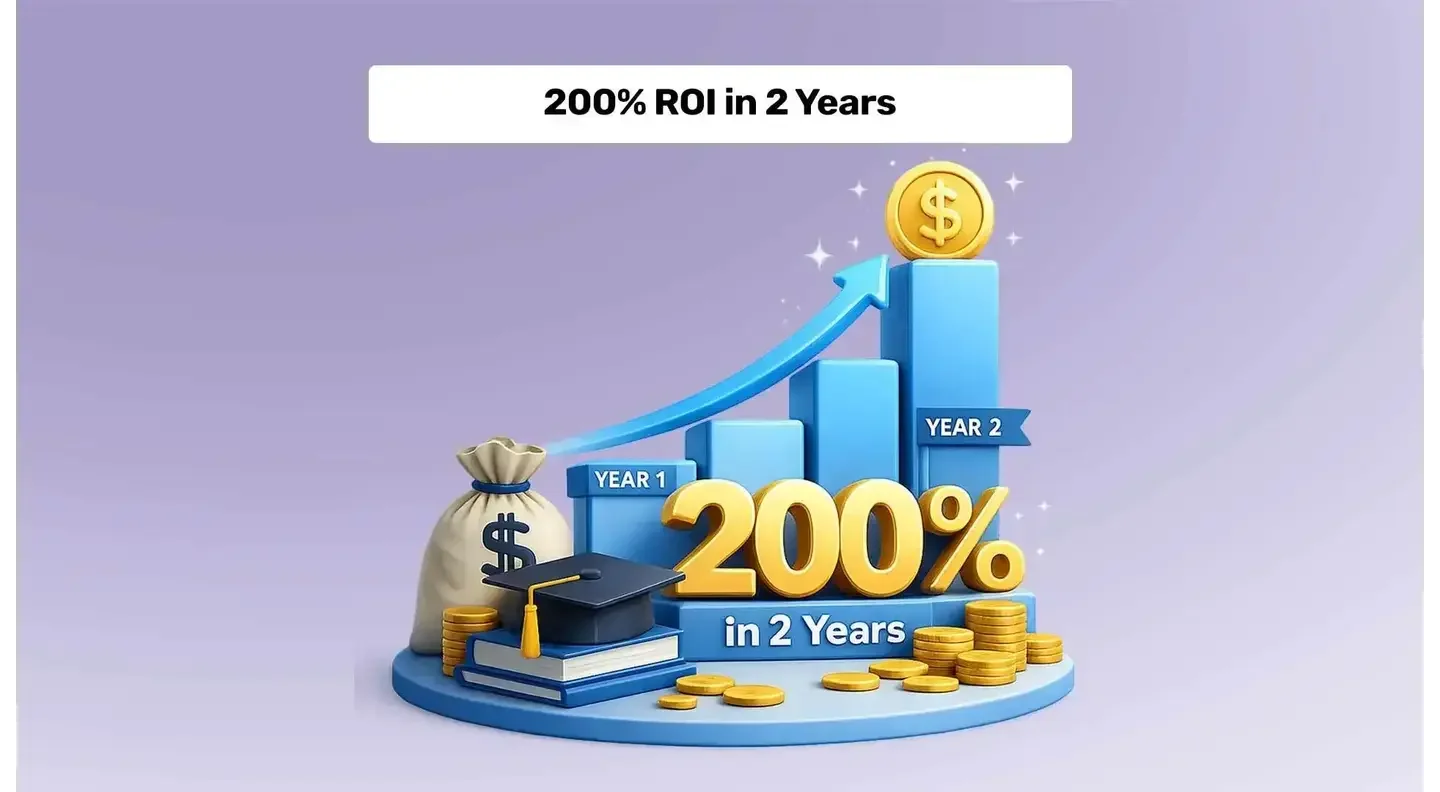
Rohan got a data scientist position with an annual income of around ₹1.2 crore, which is higher than his earnings in India, which were around ₹4.5 lakh per year after earning his MS in Data Science in the UK. The earnings were so high, and the leap was so sharp, that it was a definite resetting of his career path.
What seemed to be a financial risk at first turned out to be an expedited income growth, which justified the choice to finance the career pivot with a structured education loan.
The incremental income by itself was greater than the loan amount within the first year of employment. Even after accounting for taxes, living costs, and EMI repayments, the numbers comfortably supported the education loan career pivot ROI in India narrative.
| Characteristic | Amount |
|---|---|
|
Before pivot (Mechanical Engineer in India) Annual salary |
₹4.5 lakh |
|
Annual salary after pivot (Data Scientist in the UK)Salary after pivot (UK Data Scientist), per annum |
₹1.2 crore |
|
Net annual income increase |
₹1.155 crore |
|
Total education loan taken |
₹48 lakh |
|
First year ROI |
240% |

Rohan’s journey shows that a career pivot is not defined by courage alone, but by calculation. When evaluated through the lens of the education loan career pivot ROI in India, the loan stops being a liability and starts functioning as deployed capital. The difference lies in intent. It is hard to borrow to sustain the status quo, but it is possible to change the path of a whole career by borrowing to reset earning potential.
This case makes one thing clear. Taking a loan is not the actual danger, but continuing down the avenue where growth is limited and returns are marginal. An education loan may reduce years of gradual advancement into a less agonising but more fruitful period of development when organised appropriately and supported by market-applicable skills. Find the right loan to fund your career pivot with us.

Numerous data science courses target non-IT engineers. Mechanical engineers possess good analytical and problem-solving skills already, and with proper training, they can easily switch to data science jobs.
The amount of the loan required by most Indian students is between ₹35 lakh and ₹55 lakh, depending on university, city and lifestyle preference. This normally includes tuition, accommodation costs, transportation and visa fees.
Only when the choice is not calculated. A loan for a career change abroad increases risk when students choose courses without market demand or clear job pathways. The repayment risk is actually lower when the course is in line with high-demand positions, such as data science, as the increase in income is faster.
It is, particularly in the case of students with minimal family wealth. Non-collateral loans with a co-applicant are common for overseas programs in high-demand fields. The key is to ensure the EMI structure aligns with post-study income, not current salary.
At a minimum, three things. Expected post-study salary, total loan amount, and realistic repayment capacity. When these numbers work together, the education loan career pivot ROI in India becomes clearer and less intimidating.
Check Your Education Loan Eligibility

Ask from a community of 10K+ peers, alumni and experts
Be the first to discuss this article
Ask a question or share your experience with students on GD Connect.
Add Your ResponseTrending Blogs
Similar Blogs

Network with a community of curious students, just like you
Join our community to make connections, find answers and future roommates..Country-Wise Loans
Best Lenders for Education Loan

ICICI Bank

Axis Bank

Union Bank

Prodigy

Auxilo

Credila

IDFC

InCred

MPower

Avanse

SBI

BOB

Poonawalla

Saraswat