



.webp)




















Help our experts understand you better by filling our 2-Minute Form, to find the right education loan
Get instant loan offer suitable to your profile !

On this Page:
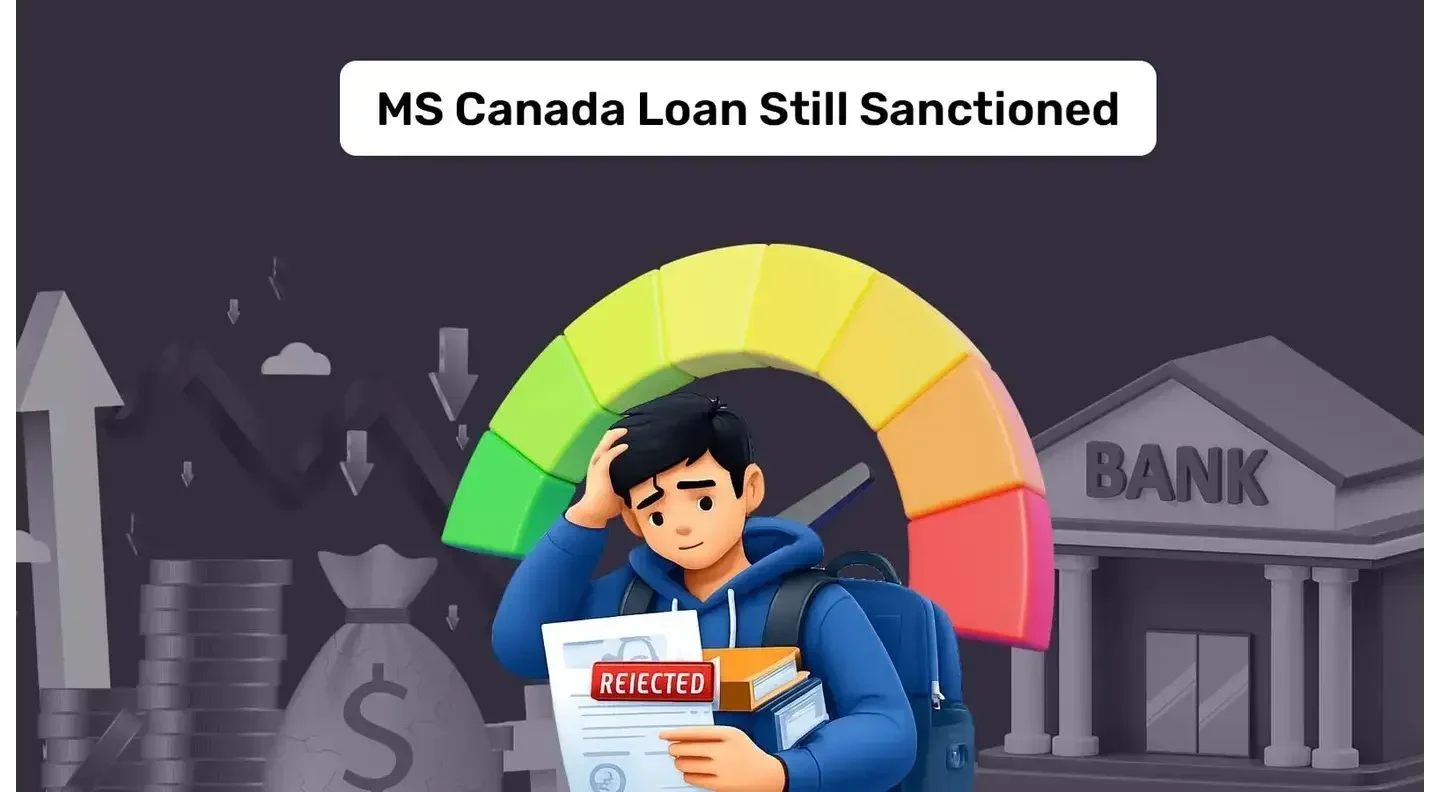
Rejected due to a low CIBIL score? See how an Indian student secured an education loan for MS in Canada despite multiple rejections, with expert guidance from GyanDhan.

Whenever a student applies for an education loan, they often miss out on an important three-digit number called the CIBIL score. But does it really matter so much? Yes, because it dictates your financial history. One missed EMI, an obligation, or a late credit card payment can impact the overall CIBIL score. Most lenders consider 650 an acceptable minimum score, and anything below that can create issues with the loan application.
Many students are unaware of the fact, like Rohit Mehra. He was a student who approached GyanDhan for an education loan for an MS in Canada after he had faced rejection from multiple banks on his study abroad loan because of a low credit score. Otherwise, he had a perfect profile with confirmed admission, a co-applicant, and great grades. However, his approval chances for an education loan were affected because of low CIBIL score in India and completely ruined his plans.
What went wrong was a single EMI that was paid three months late by the co-applicant (his father), which significantly affected his CIBIL score. Rohit even tried changing the co-applicant, but his mother, a housewife, was thus not an acceptable co-applicant. As a result, his small credit issues became an obstacle to his ambitious dream of an MS in Canada.
When Rohit first approached GyanDhan, he had already received rejections from three banks. He was eventually guided by experts to secure an education loan for an MS in Canada. Through Rohit’s journey, this article explains how families facing an education loan with a low CIBIL score India scenario can still find solutions, identify flexible lenders, and get their education funded with GyanDhan.

This case study actually follows the story of Rohit Mehra, an Indian student. He was having a strong academic profile and admission in a reputable university, but his application initially faced repeated rejections due to the low CIBIL score of the co-applicant. Let’s discuss the student profile so you can relate.
The student had secured admission for a Master’s degree in Computer Science in Canada, a program known for strong post-study employment prospects.

Academically and professionally, the profile met lender expectations, making the financial rejection particularly challenging.
The student’s father was the primary co-applicant for the education loan with a low CIBIL score in India. His father had a stable income and long-term employment; his CIBIL score stood at 570, leading to a loan rejection.
What was the reason behind the low score?
A credit card default four years ago, which was a relatively small outstanding amount that was formally settled late. But recent payments were all paid, but the old default affected the credit score.
Due to internal credit policies, two public sector banks and one private sector bank rejected the loan application without further evaluation, focusing solely on the credit score rather than the overall profile.
Rather than dropping the study abroad plan, the student and family visited GyanDhan. With GyanDhan, they applied a multi-pronged strategy was implemented to address lender concerns while strengthening the loan application.
Key outcomes of this revised approach included:
This case demonstrates that a low CIBIL score, when understood and addressed strategically, does not have to end a student’s overseas education plans.

Before we discuss the details of Rohit Mehra’s case, let’s first understand the basics. So, what is a CIBIL score? It is a 3-digit number ranging from 300 to 900, representing a borrower’s creditworthiness.
It tells your financial history, and lenders evaluate:
Since most students have little or no credit history, lenders focus heavily on the co-applicant’s CIBIL score. Public Sector Banks (PSBs) and Private Banks are often strict about the CIBIL score. There are some benchmarks they follow, which are mentioned below:
| CIBIL Score | Loan Approval Chances |
|---|---|
|
750+ |
Easy approvals and better interest rates |
|
700-749 |
Gets approved with minor scrutiny |
|
650-650 |
Approval with some conditions |
|
Below 650 |
Usually rejected, but can get approved with strong mitigation strategies |
A low CIBIL score can have a big impact when applying for high-value, long-term loans such as education loans for studying abroad. While the impact may not be immediately visible in day-to-day finances, it becomes significant during formal credit evaluations by banks and NBFCs.
Below are the key problems commonly associated with a low CIBIL score:
An education loan application is impacted by a low CIBIL score in India. Many public sector banks follow strict internal credit cut-offs, and applications with scores below the acceptable range are often declined without a detailed assessment.
This can be particularly discouraging for students who have:
A low CIBIL score significantly reduces the number of eligible lenders. Public sector banks might reject a study abroad loan application because of a low credit score. There are a few private banks and NBFCs that are open to evaluating them further. This limited flexibility can impact admission and visa timelines.
As a result, students may:
The low credit score is often perceived as a risky profile; therefore, lenders impose stricter conditions. Over time, these conditions increase the overall cost of education.
What are those conditions?
A low CIBIL score often leads lenders to demand collateral, even for loan amounts that might otherwise qualify as unsecured. Families lacking these documents find the process stressful or financially restrictive.
Common requirements include:
If you also have a low CIBIL score, you can use different strategies to mitigate its impact. You need to explore alternatives and additional documents to counter these issues. Here are some options:
These one-line pointers alone may not be sufficient for students to overcome a low CIBIL score. Therefore, detailed explanations of each option are provided below for better clarity.
In case you have 4–8 weeks before reapplying, even a small improvement can help. Thus, to improve your CIBIL score faster, you can use the following measures:
One of the best ways to overcome a low credit score is by offering collateral. Collateral acts as a security and lowers the lender’s risk. Even if the co-applicant has a low CIBIL score, the presence of a tangible asset reassures the lender.
Commonly accepted collateral is:
For Rohit Mehra, collateral was an issue because his family did not have collateral that could adequately cover the required education loan amount. However, if you do have suitable collateral, you can explore education loan options from banks such as SBI, PNB, and Canara Bank, depending on the best terms available.
Many lenders are willing to provide an education loan even with a low CIBIL score. Public sector banks often have rigid credit policies and zero tolerance. Whereas NBFCs and Private banks have flexible underwriting. They are willing to evaluate why the CIBIL score is low and even provide faster approvals.
For Rohit Mehra, the NBFC education loan with a low CIBIL worked best because:
Many families assume only parents can be co-applicants, but that’s not always true. Some lenders, such as ICICI Bank, Axis Bank, and IDFC First Bank, consider:
Lenders care more about repayment ability and credit score than relationship labels. In several loans for MS in Canada, low CIBIL cases, swapping to a co-applicant with 750+ CIBIL & stable income has led to instant approvals even without collateral.
When Rohit approached GyanDhan, his education loan application had already been rejected by three lenders, one private lender and two public sector banks. The only issue across all three rejections was his CIBIL score. These rejections had already consumed four months, leaving him with just one month for loan processing and visa application.
Hence, our first step was identifying a three-month-late payment that had significantly impacted his CIBIL score. After this, we advised him to obtain a settlement letter to address the CIBIL-related concern.
Rohit cleared his outstanding credit card dues and arranged the settlement letter. We then applied to three lenders. The first was Credila, the second was ICICI Bank, considering Rohit’s previous work experience with a monthly salary of INR 40,000, and the third was Prodigy Finance, which offers education loans without a co-applicant at an interest rate of 10.08%.
All three lenders responded within 15 days. Rohit received the best offer from ICICI Bank with an education loan at a 10% interest rate. His prior work experience, along with the settlement letter, helped build lender confidence and reduce perceived risk. His academic transcripts also played an important role in strengthening the application.
However, the decision was not based solely on the interest rate. Factors such as processing fees, repayment structure, and overall loan terms made ICICI Bank the most suitable option for him. That said, this approach does not apply uniformly to every case. Eligible and appropriate lenders vary based on individual profiles. Additional case studies have been shared below through infographics for better understanding.
A low credit score does not mean an outright rejection. As this MS in Canada case of Rohit Mehra proves, the right approach can turn rejection into approval. To counter the low-CIBIL score concern, one should understand the lender's CIBIL thresholds and use collateral. If they don’t have collateral, choose NBFCs and private banks wisely. One can even improve the CIBIL score, where possible, or they can even explore alternative co-applicants.
If you are struggling to secure an education loan due to a low CIBIL score in India, seek help from GyanDhan by checking your loan eligibility. Our experts can guide you through these challenges for FREE.
Read More:

To improve your CIBIL score faster, clear all the overdue EMIs and credit card dues immediately. Ensure that you reduce your credit card utilization below 30% of the limit. While improvement takes time, consistent discipline can show positive results within a few months.
A hard CIBIL inquiry occurs when a lender checks your credit report during a loan or credit card application. Multiple hard inquiries in a short period can negatively impact your CIBIL score, as they signal higher credit risk.
Yes, previous rejections must be disclosed and may affect future applications. However, with the right strategy and lender selection, approvals are still possible.
Yes, a settlement letter can help explain past credit issues to lenders. It shows that dues have been cleared and helps rebuild lender confidence when combined with a strong academic or professional profile.
Yes, many NBFCs offer education loans with more flexible CIBIL requirements. They evaluate the student’s profile, university, course, and future employability rather than relying only on the credit score.
Check Your Education Loan Eligibility

Ask from a community of 10K+ peers, alumni and experts
Be the first to discuss this article
Ask a question or share your experience with students on GD Connect.
Add Your ResponseTrending Blogs
Similar Blogs

Network with a community of curious students, just like you
Join our community to make connections, find answers and future roommates..Country-Wise Loans
Best Lenders for Education Loan

ICICI Bank

Axis Bank

Union Bank

Prodigy

Auxilo

Credila

IDFC

InCred

MPower

Avanse

SBI

BOB

Poonawalla
Saraswat