



.webp)











Help our experts understand you better by filling our 2-Minute Form, to find the right education loan
Get instant loan offer suitable to your profile !

On this Page:
Confused between a secured and unsecured education loan for the USA? See how the 2026 visa and RBI rules change the decision, what lenders really check, and which fits your profile.

| The Real Question | What It Actually Comes Down To in 2026 |
|---|---|
|
Secured or unsecured? |
Not just interest rates. It is about who carries the risk if your US plans get disrupted. |
|
Why the urgency now? |
A proposed US rule would cap student stay and complicate OPT, which is the exact income the unsecured lenders are betting on. |
|
Cheaper option |
Secured, almost always. Lower rate, higher limit, longer tenure. |
|
Faster option |
Unsecured, especially NBFCs and international lenders. Days, not weeks. |
|
Hidden cost of unsecured USD loans |
Rupee depreciation quietly inflates your effective cost over a 10-year repayment. |
|
What lenders silently check |
University tier, course STEM-eligibility, co-applicant FOIR, CIBIL. Not just your marksheet. |
|
The 2026 closing-loan advantage |
For floating-rate loans sanctioned or renewed from 1 January 2026, RBI banned prepayment penalties, so switching or closing early is now cheaper for either route. |
Let us walk through what has actually changed, and how a student in 2026 should think about this differently from a student in 2023.

For years, the secured vs unsecured education loan debate has followed a familiar checklist. Secured loans require collateral but usually offer lower interest rates and higher borrowing limits. Unsecured loans require no collateral, are approved faster, but typically cost more and come with lower limits.
The problem is that it answers the wrong question. It tells you the mechanics of each product. It does not tell you which one survives contact with a disrupted plan, and in 2026, disruption is the variable that changed.
Over the last few years, the U.S. has seen proposed changes to student visa rules, growing uncertainty around post-study work pathways, and a job market that is less forgiving than it was for earlier batches of international students. None of these developments changes how a secured or unsecured loan works. They do, however, change the risk of borrowing under each model.
That is why the secured vs unsecured debate is no longer just about interest rates, collateral, or approval timelines. It is about understanding which type of loan leaves you better protected if your plans do not unfold exactly as expected.
Before comparing the two, it is worth understanding what has changed and why those changes matter.
On 28 August 2025, the U.S. Department of Homeland Security (DHS) published a proposed rule in the Federal Register titled "Establishing a Fixed Time Period of Admission for Nonimmigrant Academic Students, Exchange Visitors, and Representatives of Foreign Information Media."
For more than three decades, F-1 students were admitted under Duration of Status (D/S), allowing them to remain in the United States as long as they maintained full-time enrollment and made normal academic progress.
The proposed DHS rule would replace Duration of Status (D/S) with fixed admission periods, generally up to four years for many students, while providing different admission periods and exceptions for certain categories. Students whose programs extend beyond that period would need to file a separate extension application with USCIS to remain in status.
As of mid-2026, the rule had not yet taken effect. The Office of Management and Budget (OMB) completed its review of the final rule on 17 June 2026, but DHS had not yet published the final rule in the Federal Register. Once it is published, the rule will become effective 60 days after publication.

That is the insight. The visa proposal does not make unsecured loans bad. It makes the case for stress-testing your choice against a plan-B scenario, which almost nobody does.
International lenders disburse and collect in dollars. The headline rate you are quoted is not the rate you effectively pay if you end up earning and repaying from India. Every time the rupee weakens against the dollar over your repayment years, your outstanding balance in rupee terms climbs, even as you keep making payments. A loan that looked like 12 percent can behave like something meaningfully higher in rupee reality over a decade.
If you graduate, land a US job, and repay in dollars, this is a non-issue. Your income and your debt are in the same currency. But that is exactly the assumption the 2026 visa proposal puts pressure on. Take a USD unsecured loan and end up repaying from an Indian salary, and you are now exposed to both a higher base rate and currency drift at the same time. A secured rupee loan sidesteps both.
Students assume rejection comes from weak academics. It usually does not. Across the study-abroad loan applications GyanDhan has helped process, from a base of 35,000+ students served and over ₹11,000 crore in loans facilitated, the same quiet filters decide outcomes far more than a marksheet does.
For unsecured loans, the deciding factors tend to be:
The pattern worth internalising: for a secured loan, the lender is underwriting your asset. For an unsecured loan, the lender is underwriting your future. And in 2026, your future has a new asterisk on it.

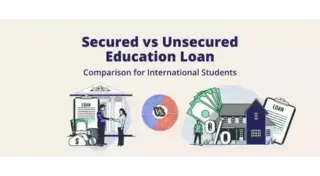
Here is the comparison of a secured vs unsecured education loan.
| Factor | Secured Loan | Unsecured Loan |
|---|---|---|
|
Collateral |
Property, FD, or other pledged asset |
None |
|
Interest rate |
Lower |
Higher |
|
Loan ceiling |
Higher, scales with asset value |
Capped, varies by lender and profile |
|
Approval speed |
Slower, needs asset valuation |
Faster, days for NBFCs and international lenders |
|
Currency risk |
None if rupee loan |
Present if USD loan repaid from India |
|
Risk if US plans disrupted |
Easier to service from Indian income |
Harder, built on US earning assumption |
|
Best fit |
Families with pledgeable assets, cost-sensitive, wanting a safety margin |
Students without assets, strong university and STEM profile, confident in US work path |
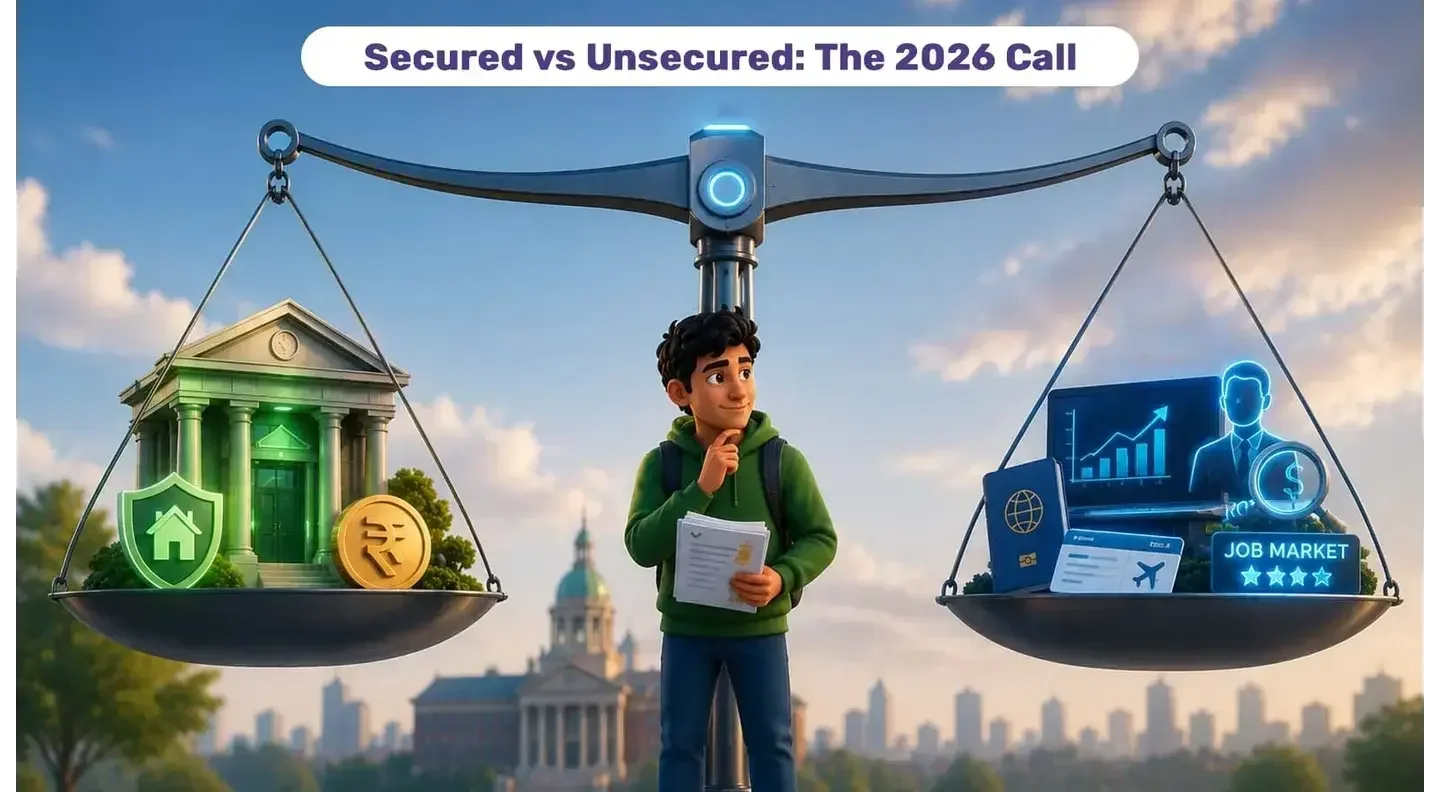
Ultimately, there is no universally correct answer on whether a secured loan is better or an unsecured one, but the risk is not symmetric. If you choose secured and your US plan goes perfectly, you have slightly over-insured, and lost a little speed. If you choose unsecured and your US plan gets disrupted, you carry a costlier, currency-exposed debt built on income that did not materialise on schedule. Given where 2026 policy is heading, over-insuring is the cheaper mistake.
There is a genuinely good development for borrowers, and it applies whichever route you pick. On 2 July 2025, the RBI issued the Reserve Bank of India (Pre-payment Charges on Loans) Directions, 2025, effective for loans sanctioned or renewed on or after 1 January 2026. Under these directions, regulated lenders cannot levy prepayment or foreclosure charges on floating-rate loans taken by individuals for non-business purposes, regardless of whether you repay from savings, a windfall, or a balance transfer to a cheaper lender.
For borrowers choosing between secured and unsecured loans, this change makes refinancing a more practical option. If speed is your priority, you can start with an unsecured floating-rate loan and later switch to a cheaper secured bank loan. One caveat worth being clear about: this protection applies to floating-rate loans from RBI-regulated Indian lenders. It does not extend to international lenders like MPOWER or Prodigy, whose USD loans sit outside the RBI's remit, so the penalty-free switch cannot be assumed on that route.
For eligible floating-rate loans, the RBI's 2025 Directions remove prepayment penalties, making refinancing easier and less expensive. That refinancing path, take speed first and price later, is now cleaner than it was before 2026. It does not erase the risks above, but it does give you room to correct the course.
Check your loan's Key Facts Statement for terms like "Repo Linked," "EBLR," or "Floating Rate" to confirm you fall under this protection. Fixed-rate loans, which are less common but still exist with some NBFC products, may still carry closure charges.
The theory is one thing. What students are actually reporting online adds texture the brochures leave out.
None of this is a reason to panic. It is a reason to keep a backup route open, which is the whole point of thinking about loan structure as risk management rather than just a rate comparison.
Strip away the noise and it comes down to your profile, not a blanket rule.
Choose a secured loan if your family can pledge an asset without straining its finances, if you want the lowest rate and the safety of a rupee loan, or if you want a repayment plan that survives a disrupted US timeline. In the 2026 environment, this is the lower-risk default for most families who can access it.
Choose an unsecured loan if you have no pledgeable asset, if your university and course sit firmly on lenders' approved and STEM-eligible lists, if your co-applicant's FOIR and CIBIL are clean, and if you are clear-eyed about currency risk on a USD loan. It is the right tool for a strong profile that values speed and cannot or does not want to pledge collateral.
And consider a hybrid approach that most families never hear about: a secured loan for the bulk of the amount to lock in the lower rate, topped up by a smaller unsecured loan for the rest. It is a legitimate structure, not a loophole, and it can balance cost against the amount of asset you are willing to put on the line.
The most expensive mistake is not choosing the "wrong" product. It is choosing without stress-testing your decision against a plan-B, in a year when the policy ground under study-abroad financing has genuinely moved. Run the numbers for your actual university, your actual co-applicant, and one scenario where your US timeline slips. Whichever loan still looks manageable in that scenario is your real answer.
If you want help modelling both routes against your specific university, course, and co-applicant profile, GyanDhan's team can run the comparison with you, including the currency and refinancing angles. Check your loan options free of cost.
Not bad, but higher-risk than before. The proposed fixed-stay rule pressures the post-study work window that unsecured lenders price on. If your university and course are strongly placed and you are confident in the US work path, it can still be the right choice. Just stress-test it against a scenario where your timeline slips.
Yes. Several Indian banks and NBFCs offer collateral-free loans up to certain limits based on your university, course employability, and co-applicant profile. Above ₹7.5 lakh, a co-applicant is effectively required for Indian unsecured loans. For no-co-applicant options, international lenders assess future earning potential instead.
If your loan is floating-rate, is from an RBI-regulated Indian lender, and was sanctioned or renewed on or after 1 January 2026, regulated lenders cannot charge prepayment or foreclosure penalties, which makes refinancing to a cheaper loan far cleaner. It does not cover fixed-rate loans, loans sanctioned before that date unless renewed after it, or loans from international lenders, which fall outside the RBI's remit. Confirm your loan is floating-rate by checking the Key Facts Statement.
Secured, in almost every case. It carries a lower interest rate, a higher borrowing ceiling, and a longer tenure. The trade-off is a slower approval and the fact that you are pledging an asset.
No. Section 80E lets an individual deduct the full interest paid on an education loan, with no upper cap, for up to eight years from the year repayment begins, and it applies to both secured and unsecured loans as long as the loan is from a recognised financial institution. The benefit is available under the old tax regime. The one practical edge with a rupee loan is that the interest, and therefore the deduction, is simpler to track than on a fluctuating USD loan. You can read the exact provision, Section 80E of the Income Tax Act, 1961, on the Income Tax Department site.
Check Your Education Loan Eligibility

Ask from a community of 10K+ peers, alumni and experts
Be the first to discuss this article
Ask a question or share your experience with students on GD Connect.
Add Your ResponseTrending Blogs
Similar Blogs

Network with a community of curious students, just like you
Join our community to make connections, find answers and future roommates..Country-Wise Loans
Best Lenders for Education Loan

ICICI Bank

Axis Bank

Union Bank

Prodigy

Auxilo

Credila

IDFC

InCred

MPower

Avanse

SBI

BOB
Poonawalla
Saraswat