



.webp)









.webp)




Help our experts understand you better by filling our 2-Minute Form, to find the right education loan
Get instant loan offer suitable to your profile !


On this Page:
Looking for a loan against marksheet? Understand eligibility, interest rates, approval factors, and application steps for education loans in India.

Not every bright student in India has the chance to realise the dreams of studying at a university of their choice. And, the reason is very clear: financial constraints. The cost of pursuing higher education in India or abroad can be very high, and to cover these expenses, education loans are available. A special education loan is a loan against a certificate or marksheet, which is a loan against educational certificates, and they can help you manage costs associated with studying abroad. The process of getting a loan on the certificate is simple. Let us first understand what a marksheet loan is, how to apply online, and how to make the process even simpler.

A loan on a certificate is also known as a student loan or education loan, given to a bright student based on their exceptional academic performance. It is also called a marksheet loan or an education certificate loan. Various public and private banks and non-banking financial companies (NBFCs) offer these loans based on your marksheets and certificates. Please note that there is a common misconception that you have to give your certificates as collateral, which is not right. No bank or NBFC in India takes your certificates as collateral. They are submitted just to check your academic performance.
Let us understand with an example, you can get a 10th-class certificate loan or a loan against educational certificates to fund your education. These loans cover tuition fees, travel costs, books, and more as per the requirements.

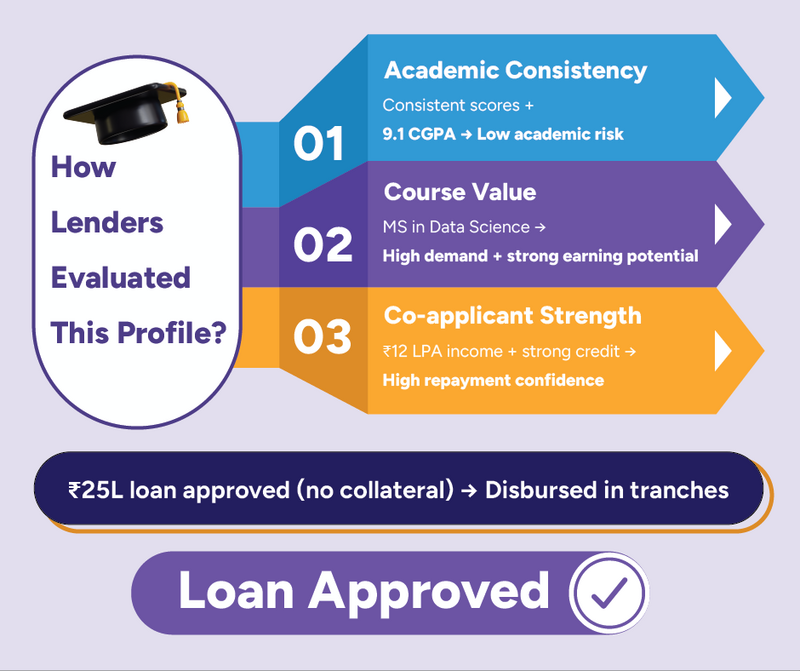
A Delhi-based student with a 9.1 CGPA in B.Tech secured admission to a top-ranked U.S. university for a Master’s in Data Science, with a total cost of ₹42 lakhs. Despite not having collateral, the applicant was able to secure a ₹25 lakh education loan on a marksheet.
The approval came down to three clear factors that lenders prioritise. The student had consistent academic performance across all levels, which reduced academic risk. The chosen program had strong placement outcomes, with high post-study earning potential, making repayment more predictable. Most importantly, the co-applicant had a stable salaried income of ₹12 lakhs per year along with a strong credit history.
Based on this combined profile, the lender approved the loan against the marksheet and structured the disbursement in tranches directly to the university. This case shows that beyond basic marksheet loan eligibility, lenders rely heavily on academic consistency, course value, and co-applicant strength when making approval decisions.
An education loan on a marksheet is best suited for students who meet certain academic and financial conditions.

Note: A loan against a marksheet works best when academic performance and future earning potential align. Lenders use both to assess risk before approval.
Marksheet loans are of great help to students who are academically bright but unable to afford higher education due to financial reasons. Let us understand the features of marksheet loans in detail:
Please note that, depending on the bank’s discretion, the loan amount may extend up to INR 50 Lakhs for studies in India and INR 1.5 Crore or higher for studies abroad under specific schemes and institutions.
Most public sector banks follow the Indian Banks' Association model education loan scheme, which standardises eligibility, collateral norms, and repayment structures.”
Let us understand the eligibility criteria for a marksheet loan. To get a loan against a marksheet, you must meet the following criteria:
Note: Lenders evaluate an education loan based on the marksheet and other deeper factors before approving. Academic consistency plays a key role as students with strong marks across 10th, 12th, and graduation are preferred. The reputation of the college and the employability of the chosen course also influence approval.
In addition, the financial profile of the co-applicant is critical. A stable income, good credit score, and repayment capacity significantly improve the chances of approval. Even if you meet the basic marksheet loan eligibility, these underlying factors often determine whether the loan is sanctioned and at what terms.
To apply for a loan against educational certificates for personal use, the following is the list of documents that are required:
For students planning to study abroad, additional documents such as the admission letter, fee structure, and visa-related documents may be required. In cases where the loan amount exceeds the non-collateral limit, property or asset documents may also be requested.
Submitting complete and accurate documents upfront can speed up the approval process for an education loan on the marksheet.

Here are the latest interest rates from banks and NBFCs on GyanDhan:
| Bank | Interest Rate | Maximum Loan Amount |
|---|---|---|
|
Starting from 8.4% to 8.9% |
Up to INR 3 Crore |
|
|
Starting from 6.75% to 10.1% |
Up to INR 1 Crore |
|
|
Starting from 7.1% to 10.2% |
Up to INR 1.5 Crore |
|
|
Starting from 9.5% to 13.25% |
Up to INR 1.5 Crore |
|
|
Starting from 6.99% to 12.5% |
Up to INR 1.5 Crore |
|
|
Starting from 9% to 12.75% |
Up to INR 2 Crore |
Note: Interest rates and loan terms may vary depending on the applicant’s academic profile, chosen course, and co-applicant’s financial strength.
Applying for a marksheet loan online is simple and easy. You can apply for a marksheet loan from a bank or an NBFC (Non-Banking Financial Company), through GyanDhan. Here is how:
A loan on a certificate in India has many benefits. Bright students can take advantage of these loans for educational certificates. Here are the advantages:
Meeting basic marksheet loan eligibility does not guarantee approval. Lenders evaluate multiple factors before approving an education loan based on the marksheet:
These factors help lenders assess whether the borrower can repay the loan after completing the course.
Even when applicants meet basic marksheet loan eligibility, an education loan on the marksheet can still be rejected due to multiple financial and academic factors. Lenders primarily assess repayment capacity through the co-applicant’s income and credit profile, and applications are often declined if the credit history is weak or the income is insufficient. Academic performance also plays a role, as inconsistent marks or admission into low-ranked institutions increase perceived risk. In addition, incomplete documentation or applying for unapproved courses or institutions can lead to rejection.
Government-backed insights further highlight structural issues in education loan approvals. A review by PRS Legislative Research on higher education financing noted that many education loan applications in India are rejected due to the absence of credit history, particularly among first-time borrowers. At the same time, regulatory guidance from the Reserve Bank of India requires banks to communicate clear reasons for loan rejection to applicants, reinforcing transparency and accountability in the lending process.
GyanDhan is India’s first education financing marketplace. Let us know why thousands of students trust GyanDhan when it comes to education loans for abroad studies:
Check your loan eligibility and start your study abroad journey!

No, you can apply for loans based on your 10th and 12th-grade certificates. Alone 10th class certificate loan is not possible.
No collateral is needed for loans up to Rs. 4 lakh. For higher amounts, collateral may be required. Please check with the bank before applying.
Yes, you can use a loan against educational certificates for travel or accommodation purposes.
Loans are usually approved within 25-30 working days. However, with GyanDhan the approval rate is faster, as it takes around 10-15 days for the loan to be processed.
Yes, GyanDhan guides you through the online loan application process and helps you get the best deal. Not only this, all the services are absolutely free of charge.
The marksheet loan interest rate typically ranges between 7% to 13% per annum, depending on the lender, course, and co-applicant’s financial profile. Public sector banks usually offer lower rates compared to private banks and NBFCs.
Check Your Education Loan Eligibility

Ask from a community of 10K+ peers, alumni and experts
Be the first to discuss this article
Ask a question or share your experience with students on GD Connect.
Add Your ResponseTrending Blogs
Similar Blogs

Network with a community of curious students, just like you
Join our community to make connections, find answers and future roommates..Country-Wise Loans
Best Lenders for Education Loan

ICICI Bank

Axis Bank

Union Bank

Prodigy

Auxilo

Credila

IDFC

InCred

MPower

Avanse

SBI

BOB
Poonawalla
Saraswat