


.webp)















Help our experts understand you better by filling our 2-Minute Form, to find the right education loan
Get instant loan offer suitable to your profile !

On this Page:
Parents don’t meet income criteria? Learn how students can get an education loan in India using a sibling as co-applicant, eligibility rules, documents, and lender policies.

Suppose this: you get the offer to study at your dream university in a foreign country, but when you start talking about the loan, everything becomes dull. Your parents either do not meet the lender’s income criteria, have existing liabilities, or are retired. The admission is secured, but financing suddenly feels uncertain. Situations like these are far more common than most students expect, and they force a critical question about who can realistically support an education loan.
This is where the concept of a sibling co-applicant education loan in India becomes highly relevant. As opposed to the common belief, education loans are no longer limited to co-applicants who are parents only. It happens that now, lenders consider the financial ability, creditworthiness, and income that the co-applicant has had, to a higher degree than their relationship with the student. A working brother or sister is more favorably placed to fulfill these requirements in most scenarios than the parents.
This strategy has, over the last couple of years, been converted into actual policy elasticity in the Indian banks and NBFCs, where education loans are being approved in an increasing number of cases on the basis of a brother or sister as a co-applicant. Although this has been a breakthrough for students with limited parental profiles, inconsistent lender policies and lack of information on documentation requirements still pose a stumbling block, thereby creating a reluctance to use the option.

When you research sibling co-applicant education loan India options, you’ll find that acceptance of relatives varies by lender type: public sector banks tend to be conservative, private banks are mixed but pragmatic, and NBFCs often offer the most flexibility.
Public sector banks typically prefer parents or legal guardians, but may accept substitutes or third-party guarantees in specific cases.

Private banks increasingly prioritise the co-applicant’s ability to repay over the exact family relationship.
NBFCs that specialise in study-abroad loans tend to be the most open to non-traditional co-applicants.

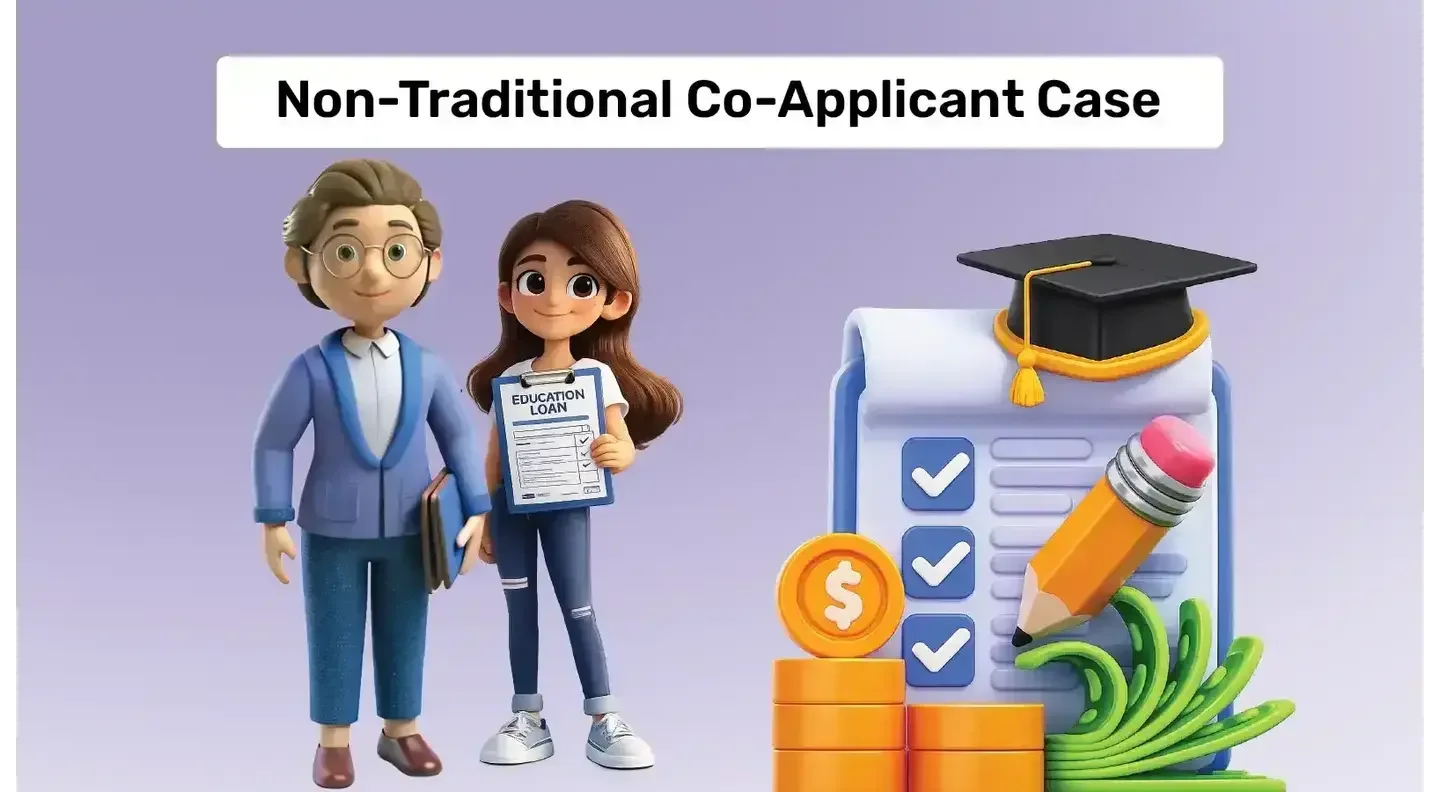
As Aarav got admission to a master's program in a foreign institution, the emphasis was now shifted to funding rather than studies. His parents, although supportive, had an irregular income because they were self-employed and had financial obligations, which meant that they were not as good co-applicants according to the normal bank rules. The loan application did not proceed to the initial phases, though Aarav satisfied all the academic and qualification criteria.
Aarav did not give up the plan, but instead, thought of an education loan with a brother or sister as a co-applicant, which he had not even considered seriously before. His older sister was employed in a private company that had a stable monthly salary, regular income tax returns, and a good CIBIL credit score. When her financial profile was evaluated, the lender changed its assessment of the relationship based on eligibility, repayment ability, and creditworthiness.
This strategy was conclusive. The application progressed under a non-traditional co-applicant study abroad loan structure, with the sibling’s income and credit history providing the reassurance lenders needed. What seemed to be a dead-end initially turned out to be a viable solution and evidence of the role that a financially stable sibling can be the key in facilitating abroad education in case parental profiles fail.
Applying for a sibling co-applicant education loan in India follows a structured documentation process. Although specific conditions differ according to the lender of choice, most banks and NBFCs emphasize the need to clearly determine the relationship, stability of income, and creditworthiness of the sibling who is the co-applicant. Developing these documents beforehand can prevent time wastage in the process of evaluation.
The following are important documents normally required by a sibling co-applicant:
Opting for a sibling co-applicant education loan in India comes with specific legal responsibilities that both the student and the co-applicant must clearly understand before proceeding. According to the lender, the sibling is not a supporting applicant but a party legally responsible for the structure of repayment.
During the time of sanction, the sibling co-applicant must sign joint liability forms, loan agreements, and repayment forms, indicating that they will be equally liable to the loan in case of default. These formalities are standard across lenders offering an education loan with a brother or sister as a co-applicant, regardless of whether the loan is secured or unsecured.
Additional undertakings can also be pursued in certain instances, such as approval of credit checks, checking of income, and even legal recovery measures in case of default in repayment. Being aware of these legal implications at the start ensures informed consent and avoids misconceptions in the future of the loan tenure.
Choosing between a parent and a sibling as a co-applicant can significantly impact approval outcomes, especially in cases involving a sibling co-applicant education loan in India. Additional undertakings can also be pursued in certain instances, such as approval of credit checks, checking of income, and even legal recovery measures in case of default in repayment. Being aware of these legal implications at the start ensures informed consent and avoids misconceptions in the future of the loan tenure.
| Parameters | Parents as Co-Applicant | Sibling as Co-Applicant |
|---|---|---|
|
Acceptability |
Widely accepted by all lenders |
Being accepted more, particularly when income and credit are good |
|
Common concern |
May face issues due to retirement, age, or existing liabilities |
Usually younger |
|
Employability & income |
Income may be fixed or inconsistent in some cases |
Regular salary and clean CIBIL can strengthen approval chances |
|
Legal formalities |
Reduced legal complexity in the family structure |
Demands definite evidence of relationship and joint liability agreement |
The eligibility of education loans is no longer confined to the conventional definitions of family support. As lender evaluations increasingly focus on repayment capacity, a sibling co-applicant education loan in India can be the difference between a stalled application and a sanctioned one, especially when parents fall short on income, age, or liabilities. The trick is to determine the financial profile of the co-applicant as soon as possible, rather than judging that the individual is ineligible. With Gyandhan, this evaluation helps students identify suitable lenders, understand documentation requirements, and approach the loan process with informed confidence rather than guesswork.

Yes, a brother can be a co-applicant in case he has good earnings, good CIBIL, and can fulfill the eligibility requirements set by the lender. Furthermore, financial strength today is measured by many banks and NBFCs on a relationship basis, and so working siblings become an option in appropriate situations.
Yes. A co-applicant who has a stable income and a good credit history increases the likelihood of approval and can help to obtain better loan terms in most cases.
In the event of default on the part of the borrower, the co-applicant will be obligated to repay. It is to be understood that a co-applicant's credit score or future borrowing capacity may be affected by tardy payments or loan distress, and as such, his/her position should be taken on the understanding that the role is a conscious decision.
A co-applicant only shares responsibility for repayment but not ownership rights over the course, degree, and subsequent earnings. A co-owner, however, usually applies to property and other assets and is entitled to own them, which is not in education loans.
The most common are parents, but spouses, siblings, or legal guardians are also welcome, depending on the income, credit profile, and the policies of the lender.
Check Your Education Loan Eligibility

Ask from a community of 10K+ peers, alumni and experts
Be the first to discuss this article
Ask a question or share your experience with students on GD Connect.
Add Your ResponseTrending Blogs
Similar Blogs

Network with a community of curious students, just like you
Join our community to make connections, find answers and future roommates..Country-Wise Loans
Best Lenders for Education Loan

ICICI Bank

Axis Bank

Union Bank

Prodigy

Auxilo

Credila

IDFC

InCred

MPower

Avanse

SBI

BOB

Poonawalla
Saraswat