



.webp)






















Help our experts understand you better by filling our 2-Minute Form, to find the right education loan
Get instant loan offer suitable to your profile !

On this Page:
Explore MBA in USA without GMAT for Indian students. Learn about GMAT waiver programs, STEM MBA benefits, costs, salaries, and eligibility.

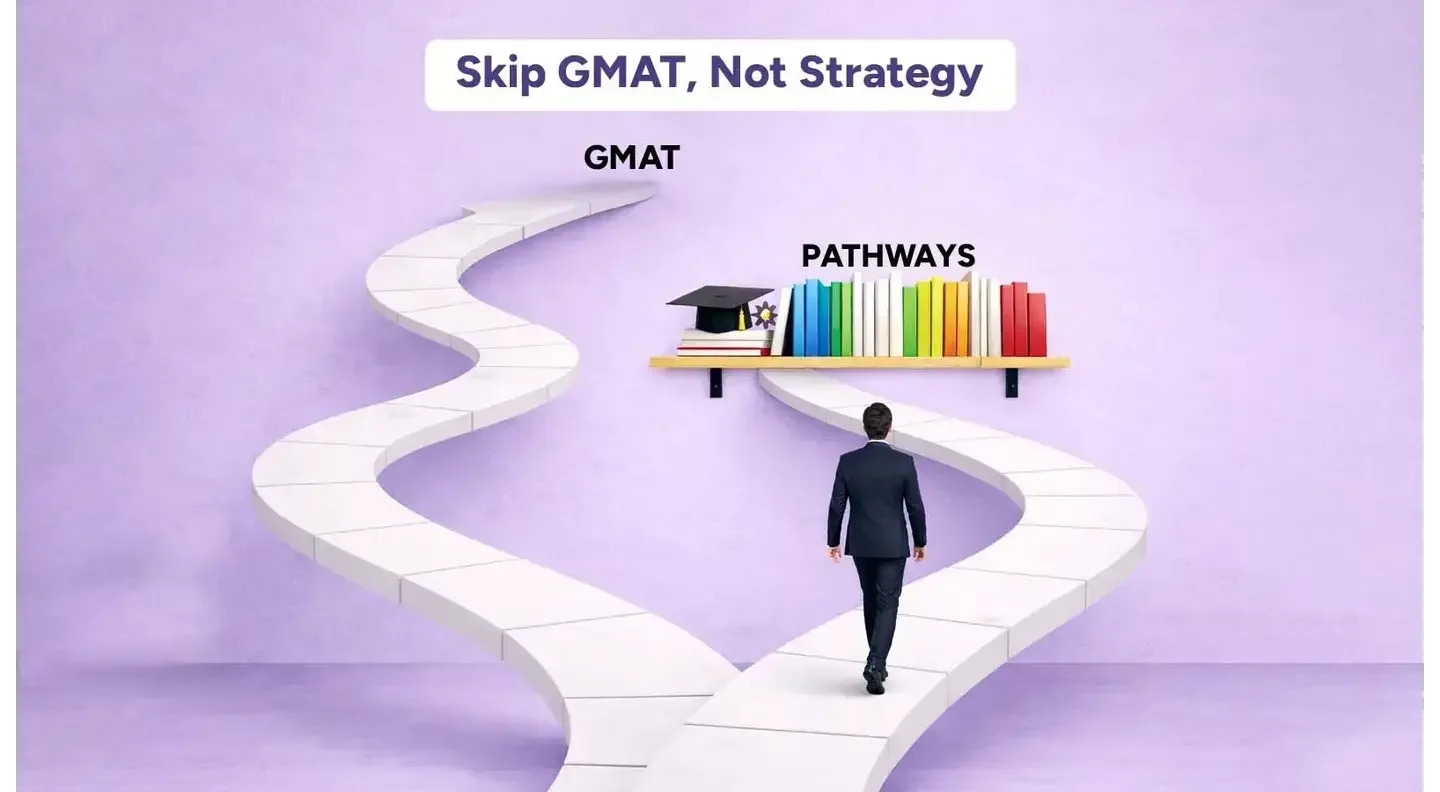
Over the years, GMAT remained in the middle of MBA admissions, determining who could and could not attend the finest business schools. After the pandemic, universities in the US have made the transition to a more holistic model of evaluation quietly, with more emphasis on work experience, leadership potential, and impact on the world. The change has created new opportunities for applicants in India who have good professional profiles and do not fall into a single test score. Today, pursuing an MBA in the USA without GMAT is no longer an exception; it’s a structured pathway supported by evolving admission policies and GMAT waiver MBA programs in the USA.


The fact that MBA is offered without the GMAT does not imply that admissions have become informal and relaxed. It applies in most instances to GMAT waivers, where universities evaluate applicants based on other criteria, including work experience, academic experience, leadership, or professional certification. It’s also important to distinguish between test-optional and test-waived programs. Test-optional programs allow you to apply without a GMAT but may still recommend it for profile strengthening, while test-waived programs formally remove the requirement altogether. Other universities might make conditional admission and might require a GMAT or its equivalent to be provided only in case academic preparation requires additional confirmation in the process of assessment.
In general, GMAT waivers are offered to a person whose professional credibility is evident but has gaps in his or her academic background. Applicants whose work experience is 5 years or more, who have acquired leadership positions and whose career development can be traced are viable candidates. Eligibility for the waiver is also enhanced by prior exposure to quantitative courses like finance, analytics, engineering, or economics. For Indian professionals, this pathway makes MBA admission in the USA without GMAT more accessible when real-world impact and decision-making ability outweigh the need for a standardized test score.
Mid-tier universities often emphasise career outcomes and practical experience over test scores. Executive MBAs and Professional MBA programs typically waive the GMAT for candidates with substantial managerial or industry exposure. Also, other MBA programs with a STEM designation are flexible, particularly to those with strong quantitative or technical skills. These formats collectively support pathways such as an executive MBA in the USA without GMAT, where professional depth matters more than standardised testing.
Rather than test results, admissions committees use a more in-depth evaluation of the professional path, decision-making process, and general preparedness for an intensive MBA experience.

The distribution of GMAT waivers is not the same in all MBA rankings. In the vast majority of the top-20 business schools, waivers are restricted, selective, and frequently conditional upon extraordinary professional or academic record. In the case of many applicants, a good program fit characterised by relevance of the curriculum, career performance, and peer profile may be more important than brand prestige itself. This is why students exploring top MBA colleges in the USA without GMAT should evaluate long-term return and alignment rather than relying purely on ranking tables.
MBAs with a STEM designation provide a powerful visa and ROI benefit, particularly to Indian students who intend to pursue long-term career opportunities in the US. These programs can add up to 36 months of Optional Practical Training (OPT) in order to provide a bigger timeframe to find employment and acquire experience in the industry and to navigate H-1B timelines, in a more calculated manner.
In the evolving admissions landscape, several universities now align this benefit with flexible entry routes, making an MBA in the USA without GMAT for Indian students more viable when paired with analytics, technology, or data-focused curricula. With the mounting pressure of employability, STEM MBAs are being increasingly viewed as a viable hedge and not a mere scholarly option.
Pursuing an MBA in the USA is a major financial commitment, with total costs often ranging between ₹50 lakh and ₹ 80 lakh, including tuition and living expenses. Opting for a GMAT waiver does not reduce this investment, which makes outcome clarity even more important. The post-MBA value without a robust post-MBA job, particularly in the consulting, technology, or management paths, may turn questionable. Realistic expectations of placement, salary increment and repayment period are necessary to ensure that the students who are dependent on education loans are not making a mistake. Students can access an end-to-end solution through Gyandhan, with expert guidance on education loans and financial decisions.
After completing an MBA without GMAT, career outcomes are directly connected to market alignment and not admission avenues. Consulting and strategy roles remain highly competitive, often favouring candidates with elite school branding or prior consulting exposure. Operations, technology and product management roles, on the other hand, are comparatively less demanding to be recruited to, particularly when one comes with pertinent company experience. For candidates pursuing an MBA in the USA with work experience, hiring outcomes tend to improve when skills, past roles, and post-MBA goals align clearly with employer expectations rather than broad prestige alone.
This route works best for applicants with clarity, not uncertainty.
In other instances, a decision not to take the GMAT may represent peril and not preparedness.
Going GMAT-free is not equivalent to opting not to work hard; it is simply a diversion of effort. With admissions becoming more profile-based, planning, positioning, and clarity now hold the same weight as test scores did previously. To stay competitive, applicants need to take time and work on career narratives, academic preparedness, and post-MBA fit. For those approaching an MBA in the USA without GMAT, success depends less on what you skip and more on how strategically you prepare for every other part of the application journey.

Many US business schools offer GMAT waivers or follow test-optional policies. Admissions are instead based on work experience, academic background, leadership exposure, and overall profile strength.
Currently, high demand includes consulting, technology, product management, analytics, and operations. MBAs with STEM-classification are particularly desirable because of enhanced employability and visa benefits.
Professional MBA, One-Year MBA and Public University MBA programs tend to be the least expensive. These programs are usually inexpensive in tuition, shorter in period and lower living costs, particularly when provided beyond the large metro cities.
On completing an MBA in the USA, the average graduate salary is between $115,000 to $145,000 annually, or about ₹95 lakh to ₹1.2 crore every year. Top business school graduates can receive salaries of up to $150,000-$180,000, with overall compensation, along with bonuses and stock option packages reaching up to $180,000-$230,000 based on position, industry and previous experience.
Check Your Education Loan Eligibility

Ask from a community of 10K+ peers, alumni and experts
Be the first to discuss this article
Ask a question or share your experience with students on GD Connect.
Add Your ResponseTrending Blogs
Similar Blogs

Network with a community of curious students, just like you
Join our community to make connections, find answers and future roommates..Country-Wise Loans
Best Lenders for Education Loan

ICICI Bank

Axis Bank

Union Bank

Prodigy

Auxilo

Credila

IDFC

InCred

MPower

Avanse

SBI

BOB

Poonawalla

Saraswat