



.webp)




















Help our experts understand you better by filling our 2-Minute Form, to find the right education loan
Get instant loan offer suitable to your profile !

On this Page:
No co-applicant for your abroad education loan? Learn realistic options, limitations, and alternative paths to secure funding in India.

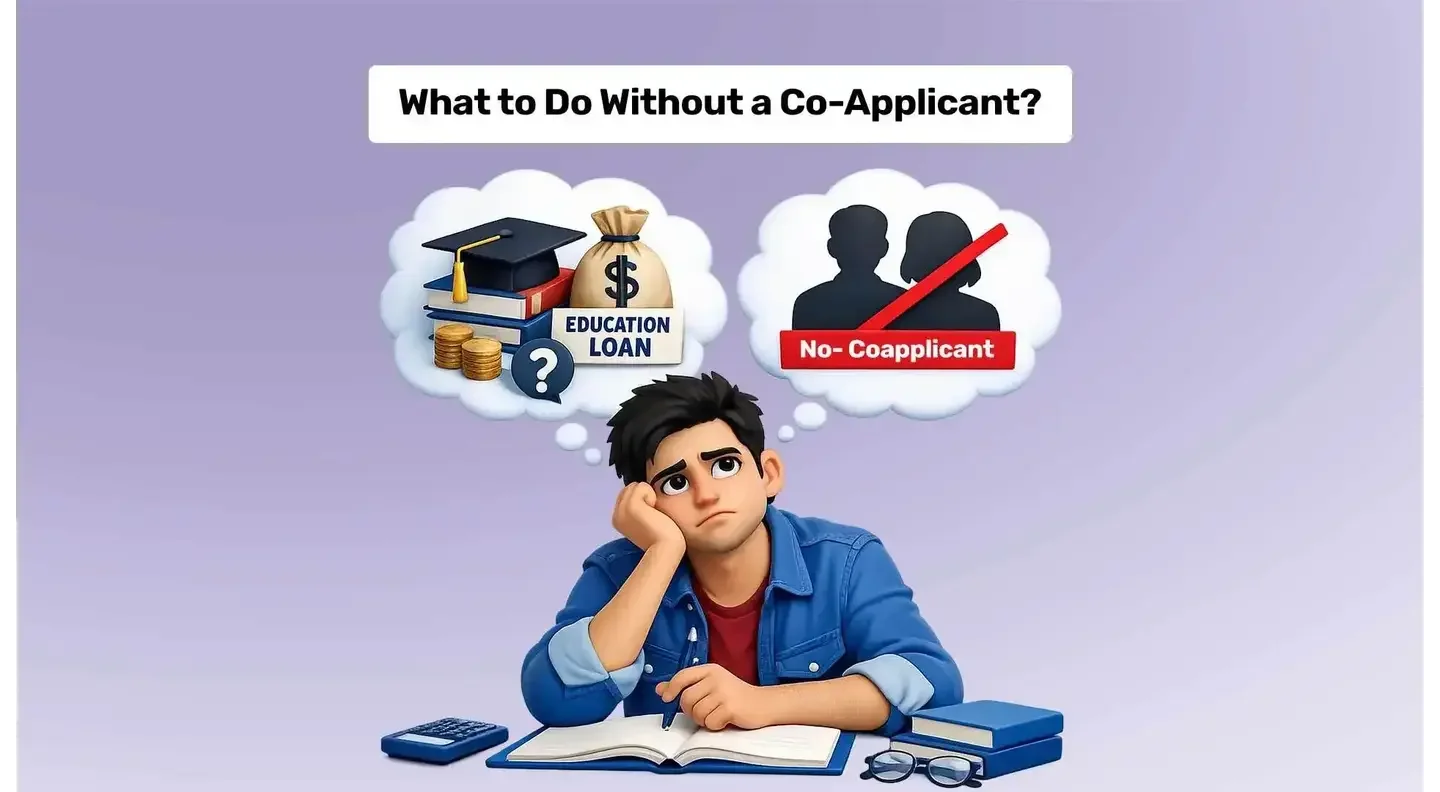
A co-applicant is usually the person who shares the legal and financial responsibility of an education loan, most often a parent or close relative whose income and credit profile help lenders manage repayment risk. When such support is unavailable, many students assume their study-abroad plans must come to a halt. In practice, it is much more challenging to get an education loan in India without a co-applicant and with more stringent conditions, but it is not completely impossible. In fewer instances, lenders scrutinize the scholarly history, the quality of the course and prospects of future income in a stringent way, thus providing narrow modes of access even without a conventional co-applicant.

A co-applicant is not only a paperwork process to most Indian lenders, but also a legal and financial requirement embedded within the education loan framework. In an education loan without a co-applicant in India, the lender bears the entire repayment risk based solely on the student’s future income, which is inherently uncertain at the time of sanction. This is the reason why banks and other financial institutions have a tendency to insist on a co-applicant who has a steady flow of income in accord with credit history and legal standing in India. The role of the co-applicant goes beyond paperwork, and they also share the responsibility of repayment, in particular during the study period and moratorium when the student does not earn active income. In the case of an abroad education loan with no co-applicant, the absence of this financial backstop makes risk assessment significantly harder, leading most lenders to either decline such applications outright or impose much stricter eligibility criteria.
The basis of this requirement is regulatory prudence and not a lack of trust in the student. Education loans are high-duration investments, and lenders turn to the financial profile of the co-applicant to cover the disbursement-employability gap.

For students struggling to secure an education loan without a co-applicant in India, collateral-backed loans remain the most commonly accepted solution. The main risk of the lender in this structure is alleviated by tangible security like residential property, fixed deposits or other approved assets, and this eliminates their reliance on the income profile of the co-applicant. As a result, the financial role of a co-applicant is significantly minimized compared to unsecured loans.
However, this does not mean the process is entirely independent. Even in cases resembling a non-collateral loan without a co-signer alternative, lenders usually require a legal guardian or the collateral owner to be associated with the loan, mainly for documentation, charge creation, and legal enforceability.
Practically speaking, collateral causes the switch of emphasis towards monthly income to asset value and ownership clarity. While this option opens doors for students without earning parents, it still involves a responsible adult’s legal participation, making it a workaround rather than a complete substitute for a traditional co-applicant structure.
A non-collateral loan without a co-signer is often assumed to be the most accessible option for independent students, but in practice, it is the most restrictive. Non-collateral education loans are designed with shared liability being their key aspect, in which underwriters are highly dependent on a co-applicant, typically a parent or legal guardian, to share the risk. Without an asset to fall back on, the co-applicant’s income stability and credit history become central to the approval decision, not supplementary.
For students who are genuinely alone, with no parent, guardian, or earning relative available, this route becomes extremely narrow. Most lenders do not have underwriting models designed to approve unsecured study-abroad loans based solely on a student’s future earning potential. As a result, applications in this category are often declined early, not due to academic merit, but because the loan structure itself requires shared financial accountability from the outset.
When exploring an education loan without a co-applicant in India, many students overlook the fact that lenders often allow flexibility in who can legally act as a co-applicant. Although parents are the most usual option, they are not the only option. In some situations, other close relatives are allowed by banks and NBFCs to share the responsibility of repayment on conditions that their source of income, credit profile and legal relation can be clearly determined. This becomes particularly relevant for students seeking an abroad education loan with no co-applicant, where redefining eligibility can unlock otherwise closed pathways.
The commonly accepted alternative co-applicants are usually a working sibling, a parent-in-law when the applicant is married and the extended family, like an aunt or an uncle. Relationships are not the most important thing, but rather the capacity of the individual to show consistent or steady income, good credit record and intent to bear joint legal responsibility.
In India, the idea of a true student-only loan remains largely a myth. Contrary to popular belief, Indian banks never provide education loans in which the student is the only borrower, no matter how good or bad academically or in which university they are enrolled. Even for students searching for a student loan for study abroad with no parent co-applicant, the underlying lending model still requires either joint liability or asset-backed security to manage repayment risk during the study and moratorium period.
That said, a narrow alternative exists outside the Indian banking system. A few international lenders, such as Prodigy Finance and MPower Financing, offer student-only loan products for overseas education. These lenders evaluate applications based on factors such as university ranking, course employability, and projected post-study income rather than family backing. Nevertheless, they are very selective and are normally restricted to certain countries and organizations, with higher interest rates and stricter terms of repayment. For Indian students, they remain niche possibilities rather than mainstream substitutes for domestic education loans.
When a co-applicant is not an option, students seeking an abroad education loan with no co-applicant must take a more strategic approach. The steps below focus on reducing lender risk and identifying the few viable pathways available in such cases.
Go beyond parents and look at extended family members, e.g. a working sibling, an uncle, an aunt, as long as they can prove to have a stable income, acceptable credit history, and readiness to become legally responsible.
Apply for merit-based scholarships, need-based grants, teaching or research assistantships, and university fee waivers to lower the total funding gap and improve lender comfort.
Even collateral of limited value, like a fixed deposit or property owned in common, can reinforce a case as it causes the lender to begin to base his risk judgment on other factors than income alone.
When the possibility of domestic financing is no longer an option, investigate foreign lenders who use university ranking and employability as criteria, but also take into consideration the existence of higher interest rates and more stringent repayment schemes.
High academic scores, relevant work experience, and admission from reputable institutions improve credibility, especially in cases involving an education loan for study abroad with no parent co-applicant.
Sending several poor applications may result in early rejections. GyanDhan helps evaluate your profile across banks and NBFCs to identify the few lenders willing to assess complex cases before you apply.
Securing an education loan without a co-applicant in India is one of the most restrictive funding situations for students planning to study abroad, but it is not entirely closed off. The process demands clarity about what lenders will and will not consider, along with a willingness to move beyond standard assumptions. Options such as collateral-backed structures, extended family co-applicants, or carefully selected international lenders require deliberate positioning rather than trial-and-error applications. Outcomes in such cases depend less on eligibility checklists and more on how thoughtfully the application is structured. Let our experts help you find a suitable co-applicant or alternative financing.

In India, this is possible only in limited situations. Most students either rely on strong collateral, bring in an alternative eligible relative, or explore select international lenders. Applying without a clear strategy usually leads to rejection, so the structure of the application matters more than intent.
Banks emphasize repayment capability and not the relationship itself. The main elements that are looked at by the lenders are a stable source of income, a track record of employment, satisfactory credit practices and legal readiness to share the liability.
Most lenders prefer a co-signer's credit score in the 650-750 range or higher. A low score can also be taken into consideration, but would influence the loan amount, interest rate, or the time of approval.
There are still some institutions that might take the application when income stability is high and liabilities are manageable, yet the terms are often more stringent, and approval is not assured.
Income itself does not directly impact a credit score. However, income influences repayment behaviour, which in turn affects credit history. Actually, low scores are caused by missed payments, excessive use of credit or defaults.
Check Your Education Loan Eligibility

Ask from a community of 10K+ peers, alumni and experts
Be the first to discuss this article
Ask a question or share your experience with students on GD Connect.
Add Your ResponseTrending Blogs
Similar Blogs

Network with a community of curious students, just like you
Join our community to make connections, find answers and future roommates..Country-Wise Loans
Best Lenders for Education Loan

ICICI Bank

Axis Bank

Union Bank

Prodigy

Auxilo

Credila

IDFC

InCred

MPower

Avanse

SBI

BOB

Poonawalla

Saraswat