



.webp)








.webp)
.webp)




Help our experts understand you better by filling our 2-Minute Form, to find the right education loan
Get instant loan offer suitable to your profile !


On this Page:
Understand the consequences of not repaying an education loan. Learn about the financial and legal implications for managing education loan default.

What happens if an education loan is not paid in India? This is a growing concern for many students facing financial challenges after graduation. Even a few missed EMIs can lead to education loan default, affecting your credit score and triggering recovery actions. Recent data from the Reserve Bank of India (RBI, Report on Trend and Progress of Banking in India, 2024-25) shows that education loans continue to remain a stressed segment within retail lending, with public sector banks reporting gross NPAs in education loans at around 7% significantly higher than the overall retail loan Non-Performing Asset (NPA) ratio.
In reality, what will happen if an education loan is not paid goes beyond penalties. It can involve guarantors and even legal action against education loan defaulters in India. While many worry, can I go to jail for not paying education loan in India, the consequences are primarily financial and legal. This blog explains what happens when an education loan becomes NPA and how borrowers can manage the situation before it escalates.

Education loans in India are categorized mainly into two types:

Lenders in the Indian education loan market include:
| Lender type | Features |
|---|---|
|
Lower interest rates, require collateral, longer processing times. |
|
|
Competitive rates, faster processing, may or may not require collateral. |
|
|
NBFCs (Non-Banking Financial Companies) |
Higher interest rates, flexible terms, often offer unsecured loans. |
|
Specialize in loans for studying abroad, competitive rates, may not require collateral in India. |
In reality, what happens if an education loan is not paid depends less on theory and more on how aggressively the lender recovers dues. Once an account turns NPA (90+ days overdue), public sector banks typically follow a slower, notice-driven process before escalation.
Private banks and NBFCs, however, often begin follow-ups much earlier, sometimes within the first missed EMI through calls, reminders, and third-party collection agencies. This is why in an education loan default, borrowers may experience very different recovery pressure, even before any formal legal action against education loan defaulters in India begins.

Not all cases of education loan default are treated the same. As per the Reserve Bank of India, a borrower may be classified as a wilful defaulter if they have the capacity to repay but deliberately avoid payment, divert loan funds for other uses, or dispose of collateral without informing the lender.
This distinction matters because lenders take stricter action in such cases. Wilful defaulters can face legal proceedings, including action under fraud provisions such as IPC Section 420 in extreme cases. Banks may also report and publish names of wilful defaulters and restrict access to future credit across institutions.
In contrast, borrowers facing genuine financial hardship such as job loss or income disruption are typically considered for restructuring, moratoriums, or revised repayment terms, especially before the loan turns NPA.
Understanding this difference is critical, as what happens if an education loan is not paid depends not just on delay, but on borrower intent and repayment behaviour.
Understanding what happens if you don't pay your college loan exposes immediate implications that can have a substantial influence on your financial situation and relationships with lenders. These consequences are not confined to a decline in your credit score, but also affect other elements of your financial life, demonstrating the gravity of defaulting on loan obligations.
| Lender Type | Typical Practice |
|---|---|
|
Banks |
1–2% over existing interest rate* |
|
NBFCs |
Higher variation depending on risk profile* |
*Exact charges vary by lender and are defined in the loan agreement.
Long-term Impact of Not Repaying Education Loan
The consequences of not repaying a school debt go far beyond immediate financial misery, including long-term employment opportunities, legal status, and even personal relationships.
How Long-Term Impact Actually Plays Out?
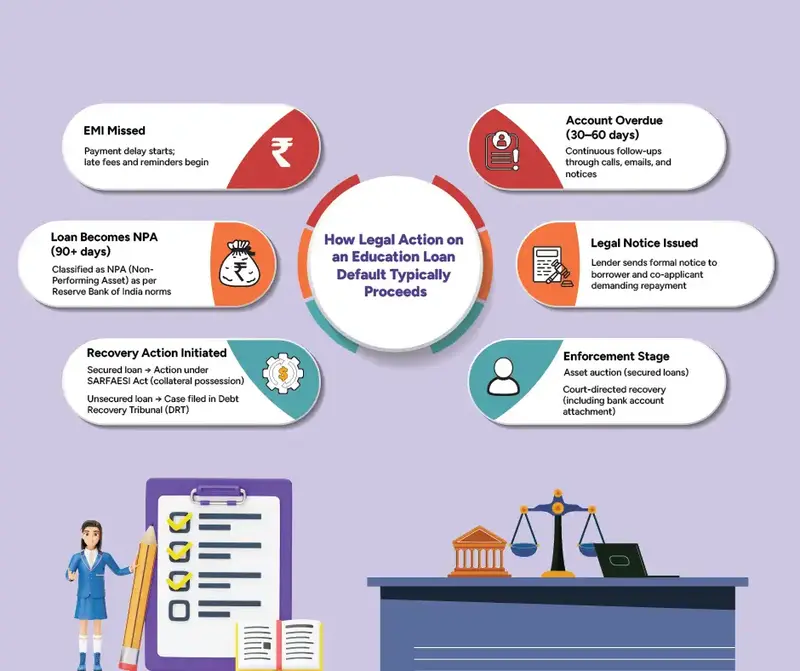
Once an education loan default crosses the NPA stage, lenders initiate recovery under applicable laws. In secured loans, banks proceed under the SARFAESI Act to take possession of collateral and auction it after due notice.
In unsecured loans, cases move to the Debt Recovery Tribunal (DRT), where both the borrower and co-applicant are held liable. Credit scores drop, and future loan eligibility is restricted.
This is what happens if an education loan is not paid, it turns into a long-term financial constraint that directly impacts borrowing ability and financial credibility.
To mitigate the impact of legal action against education loan defaulters in India, governments, and financial institutions have implemented measures aimed at providing relief to borrowers, ensuring that the consequences do not become insurmountable barriers to financial recovery.
In one case reported through a bank grievance channel, a borrower who was actively repaying his education loan began receiving repeated recovery calls stating that EMIs were overdue. Even after sharing transaction details and payment proofs with the branch, the issue continued for weeks without resolution.
The situation escalated when recovery communication was also sent to the co-applicant, despite no actual default. After internal complaints failed to resolve the issue, the borrower escalated it to the Reserve Bank of India Ombudsman. The bank later identified it as a reporting error, corrected the loan status, and withdrew all recovery actions.
This highlights that even outside an actual education loan default, recovery processes can sometimes be triggered incorrectly and borrowers have the right to escalate such cases through formal channels.
In India, if someone defaults on their education loan, the following legal actions can be taken against them:
Even in an education loan default, borrowers are protected under guidelines issued by the Reserve Bank of India. Lenders are required to follow a fair and transparent recovery process.
Having difficulty repaying your college debt might be overwhelming, but there are techniques and steps you can take to properly manage your position and avoid the severe repercussions of default.
Note: Repayment support is typically considered while the loan remains regular. Once it is classified as an NPA, lenders shift to recovery as per Reserve Bank of India norms, leaving limited scope for adjustments
Also Read:
Riya Sharma took a ₹52 lakh education loan from a private bank to pursue an MSc in Data Science in the UK. Her father, a salaried government employee earning ₹12 lakh annually, was the co-applicant and initially handled repayments during the course period. For 3.5 years, EMIs were paid regularly.
After graduation in 2024, Riya entered a highly competitive job market where hiring slowed down across tech roles. Within two months of the repayment cycle shifting fully to her, EMIs started getting delayed. Despite initial assurances, her co-applicant was unable to continue repayments due to existing financial commitments and rising household expenses.
At this stage, the account was treated as an education loan default, and further escalation opened the possibility of legal action against education loan defaulters in India, including recovery proceedings against the co-applicant’s financial standing.
If you’re facing repayment challenges, addressing them early is critical. Delays in action often lead to an education loan default, and once the account is classified as an NPA, available options become significantly limited. Evaluating repayment strategies, understanding lender policies, and taking timely steps such as restructuring or refinancing which can prevent escalation and reduce long-term financial impact.
Making informed decisions at the right stage is what ultimately determines whether a temporary difficulty remains manageable or turns into a prolonged financial burden.
Check your eligibility and explore tailored education loan options with GyanDhan.

No, not repaying an education loan is a civil matter, not a criminal offence. However, continued education loan default can lead to recovery proceedings, legal notices, and action against collateral or guarantors.
Missing a payment can result in your loan becoming delinquent, affecting your credit score, and potentially leading to late fees.
Delinquency is reported to credit bureaus after 90 days for federal student loans and potentially sooner for private loans.
In India, a loan is considered delinquent as soon as an EMI is missed. If the payment remains overdue for more than 90 days, the loan is classified as an NPA (Non-Performing Asset) as per Reserve Bank of India norms, which effectively marks the stage of education loan default.
Yes, defaulting on a student loan can make you ineligible for future federal student aid.
When an education loan becomes a Non-Performing Asset (NPA), it means the borrower has defaulted on payments for 90 days or more. The lender may initiate recovery actions, report it to CIBIL, Experian, and Equifax., and the borrower's credit score will be negatively impacted.
Check Your Education Loan Eligibility

Ask from a community of 10K+ peers, alumni and experts
Be the first to discuss this article
Ask a question or share your experience with students on GD Connect.
Add Your ResponseTrending Blogs
Similar Blogs

Network with a community of curious students, just like you
Join our community to make connections, find answers and future roommates..Country-Wise Loans
Best Lenders for Education Loan

ICICI Bank

Axis Bank

Union Bank

Prodigy

Auxilo

Credila

IDFC

InCred

MPower

Avanse

SBI

BOB

Poonawalla
Saraswat