



.webp)














Help our experts understand you better by filling our 2-Minute Form, to find the right education loan
Get instant loan offer suitable to your profile !

On this Page:
Compare STEM vs non-STEM courses in the USA based on OPT duration, jobs, salaries, visa impact, costs, and long-term ROI.

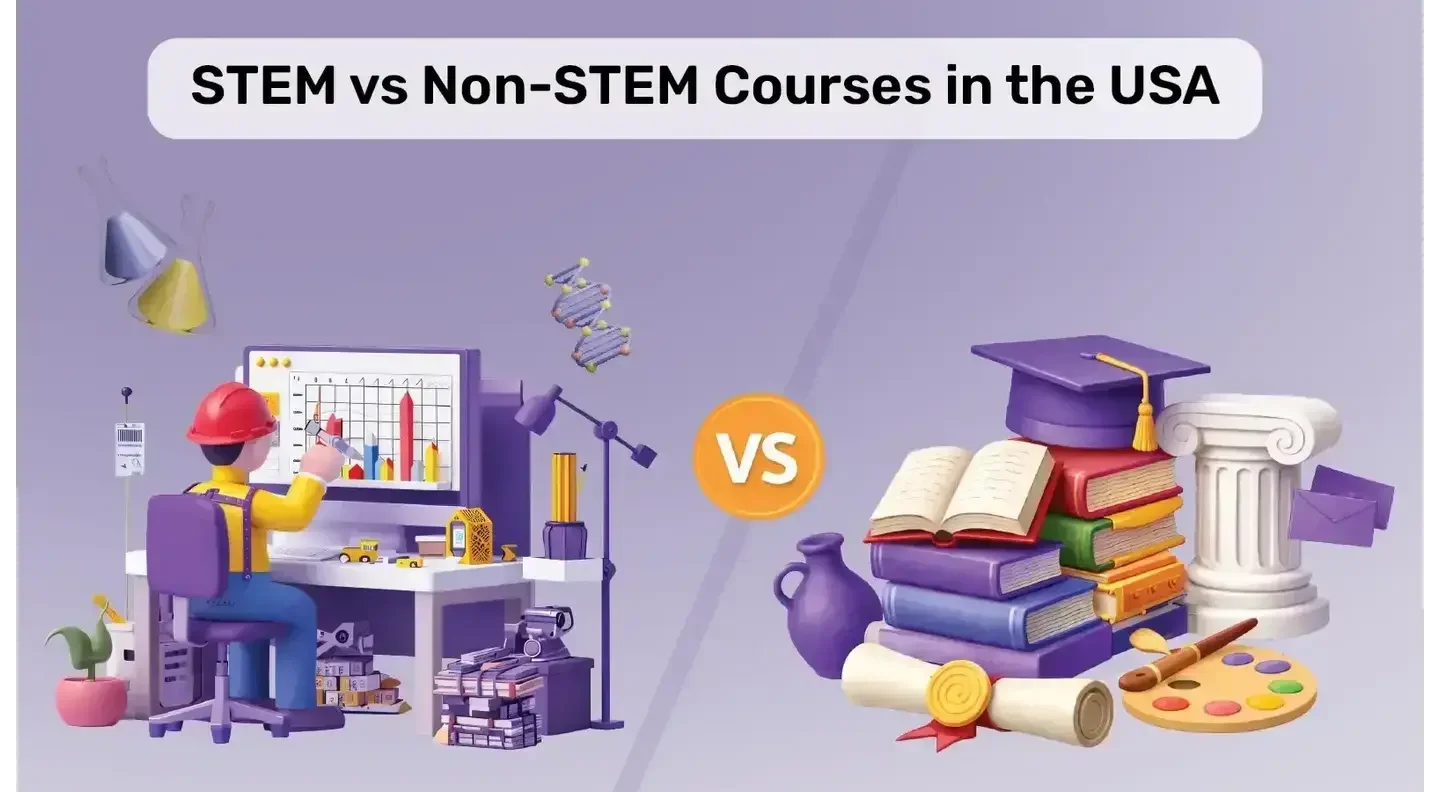
Every student has to choose between STEM and non-STEM courses when planning to study in the U.S. This decision is also crucial because it affects their entire career and can even impact their visa outcomes. That’s why we have done detailed research and created this comprehensive guide for you.
Strong job prospects, longer-term employment authorization, and a higher return on investment have all contributed to the recent sharp rise in demand for STEM courses in the US. However, students interested in management, business, the arts, policy, and leadership roles continue to turn to non-STEM courses in the US.
Thus, both STEM and non-STEM courses are great options in terms of career prospects and practical considerations. Students just need to identify the best course for themselves based on their priorities and skills. We have even explained the visa policies, OPT duration, job opportunities, salaries, and long-term career outcomes, while keeping recent policy changes in mind.

STEM is an abbreviation of Science, Technology, Engineering, and Mathematics. Thus, it includes the programs that combine technical knowledge with applied scientific and mathematical skills.
In short, they are research-based programs designed to build technical, analytical, and problem-solving skills that are in high demand globally. Many universities publish an official list of STEM courses in the USA approved by the Department of Homeland Security (DHS).
| STEM Field | Degree Examples |
|---|---|
|
Engineering |
MS in Electrical Engineering, MS in Mechanical Engineering |
|
Computer Science |
MS in Computer Science, Software Engineering |
|
Data & AI |
MS in Data Science, Artificial Intelligence, Machine Learning |
|
Analytics |
MS in Business Analytics, Information Systems |
|
Life Sciences |
MS in Biotechnology, Life Sciences |
|
Mathematics |
MS in Mathematics, Applied Statistics |
|
Business (STEM-designated) |
MS STEM coursn the USA in Business Analytics |
|
Architecture |
STEM architecture coursn the USA (STEM-designated tracks) |
Unlike STEM programs, non-STEM courses are less technical, and they focus on leadership, communication, strategy, and domain expertise rather than technical depth. Students learn skills such as critical thinking, decision-making, and people management. Many Indian students from commerce or arts backgrounds explore non-STEM courses in the USA.
Non-STEM courses have been linked with a misconception. Students believe that non-STEM programs pay less or have fewer choices for careers. In reality, networking, industry exposure, internships, and institution selection play a major role in non-STEM field outcomes.
The flexibility of non-STEM programs is one of their main advantages. Graduates can choose to move to different regions and industries. Due to their strong alumni networks and leadership-focused career paths, popular non-STEM programs like an MBA, Master's in Finance, and Public Policy continue to recruit international students.
| Non-STEM Field | Degree Examples |
|---|---|
|
Management |
MBA (non-STEM track) |
|
Finance, Marketing, HR |
Master’s in Finance, Master’s in Marketing |
|
Economics & International Relations |
MA in Economics, MA in International Relations |
|
Public Policy & Public Administration |
MA in Public Policy, MPA |
|
Humanities, Liberal Arts, Design & Media |
Master’s in Design, Master’s in Communication |

Both STEM and non-STEM courses have their own advantage and expertise, but upon comparison, it helps students assess which option aligns better with their academic background, career goals, and visa plans.
STEM and non-STEM programs in the USA are offered across multiple academic levels, and the course duration is generally similar for both.

Academic duration is the same for both STEM and non-STEM programs in the USA; the difference lies in the experience and skills:
STEM courses often include:
Non-STEM courses focus more on:
OPT (Optional Practical Training) is the extension given to students during which they can look for employment and gain practical experience. For both streams, it comes with a few rigid rules that students must clearly understand.
In terms of duration:
However, many students are unaware of the fact that not all degrees qualify for OPT. Certificate programs, short-term diplomas, non-degree programs, and courses offered by institutions that are not accredited or not SEVP-approved are not eligible for OPT.
The STEM OPT extension is available to programs that are officially included in the DHS STEM list. As a result, before enrolling in any course or university, students should review the list. These rules have significant effects on international students' long-term planning and job search flexibility.
Due to a lack of experience in technology, data, and engineering, STEM job opportunities are still in high demand. Demand for STEM graduates was comparatively higher even during periods of political unpredictability and tougher immigration laws.
Non-STEM positions are more susceptible to shifts in policy and economic cycles. Hiring in fields like management, consulting, and policy is sensitive to political unpredictability because it frequently depends on market conditions, networking strength, and employer sponsorship willingness.
From a visa perspective, STEM courses offer a clearer advantage:
Non-STEM students face tighter timelines, making early planning, internships, and employer targeting extremely important.
Quick Synopsis: STEM vs Non-STEM Courses in the USA
| Factor | STEM Courses | Non-STEM Courses |
|---|---|---|
|
Program Focus |
Technical & analytical |
Managerial, creative, policy-oriented |
|
Course Levels |
Bachelor’s, Master’s, PhD |
Bachelor’s, Master’s, PhD |
|
OPT Duration |
Up to 36 months |
12 months |
|
Job Market |
Skill-driven, relatively resilient |
Competitive, economy, and network-driven |
|
Visa Advantage |
Stronger |
Limited |
Visa policies influence the post-study opportunities in the USA. Over the years, a few changes have been observed in visa policies, employer sponsorship norms, and compliance requirements.
In recent years, students have seen:
When students finally enter the country, they have to follow a few norms during their student visa duration, but on completion, they apply for the OPT. It is a bridge between education and long-term work visas. While details vary by course type, OPT allows students a limited time to gain relevant work experience and secure employer sponsorship.
Non-STEM courses have 12 months of eligibility for OPT, out of which students must secure employment within 90 days. But, for STEM courses, the OPT is eligible for 36 months with 150 days of unemployment limit before the OPT gets terminated.
Thus, non-STEM students need to build a strong network and actively look for employment. This helps them use their OPT period to the fullest and transition from a study visa to a work permit sooner.
In general, the course selected, industry demand, employer, and prompt adherence to immigration regulations all influence visa outcomes. A student's chances of remaining and working in the US after graduation can be greatly increased by careful planning and knowledge of current visa trends.
The job market of a country is sensitive to its economic cycle, technological advancement, and immigration policies. In this scenario, the U.S. is flourishing and has high demands of STEM roles because of skills shortages in technology, data, and engineering. Similarly, non-STEM fields are also generating steady opportunities in management, healthcare administration, policy, design, education, and business operations.
However, the job market, regardless of STEM or non-STEM programs, is considering skilled individuals. Therefore, a successful job outcomes depend on early preparation and strategic execution:
STEM graduates enter technical and analytical roles where demand remains strong due to innovation-led growth. Common job roles include:
These roles offer higher starting salaries and stronger long-term earning potential, making STEM courses attractive from an ROI perspective.
Non-STEM graduates often find opportunities in leadership, strategy, people management, and creative or policy-driven roles. Popular job profiles include:
While non-STEM salaries may be comparatively moderate at the entry level, career growth can be strong with experience, industry exposure, and networking.
| Course Type | Average Annual Salary (USD) | Average Course Cost (USD) | ROI |
|---|---|---|---|
|
STEM |
80,000 – 120,000 |
60,000 – 100,000 |
High |
|
Non-STEM |
55,000 – 85,000 |
50,000 – 90,000 |
Moderate |
The cost of education in the USA varies significantly by university, program, and demographics. Usually, STEM programs offer high earning potential upon graduation, but they also require high investments due to lab usage, technology infrastructure, and industry-aligned coursework. While non-STEM programs are relatively moderate but still premium at top-ranked institutions.
Below is an indicative annual tuition range for popular STEM and non-STEM courses at some of the top universities. Actual costs may vary by specialization and year of intake.
| University | STEM Course (Example) | Approx. Annual Cost | Non-STEM Course (Example) |
|---|---|---|---|
|
MS in Computer Science |
USD 75,000–80,000 |
MBA / Management Studies |
|
|
MS in Data Science |
USD 52,000–55,000 |
MS in International Policy |
|
|
MS in Biotechnology |
USD 50,000–54,000 |
MPA / Public Policy |
|
|
MS in Engineering |
USD 38,000–42,000 |
MS in Economics |
|
|
MS in Analytics |
USD 33,000–37,000 |
MS in Communication |
|
|
MS in AI / CS |
USD 58,000–62,000 |
MS in Finance |
|
|
MS in Robotics |
USD 38,000–42,000 |
MS in Public Health |
|
|
MS in Cybersecurity |
USD 48,000–52,000 |
MS in Marketing |
|
|
MS in Computer Engineering |
USD 30,000–34,000 |
MS in Global Policy |
|
|
MS in Data Science |
USD 28,000–32,000 |
MA in Economics |
Note: This table includes only the tuition fee and doesn’t include the living costs and other miscellaneous costs.

There are a few documents that are required for both STEM & non-STEM courses. These general documents include:
But based on the course, the admission requirements can vary. For instance, STEM courses require:
On the other hand, non-STEM admissions require:
During the initial years, STEM graduates begin with entry-level roles such as Software Engineer, Data Analyst, or Research Associate, where students learn & apply technical skills gained during their coursework and internships. With 3–5 years of experience, professionals often move into mid-level positions like Senior Engineer, Product Manager, or Data Scientist, taking on greater ownership of projects and teams.
Over the long term, STEM graduates can progress into advanced leadership or specialist roles such as Technical Architect, Engineering Manager, or even CTO-track positions. Salary growth in STEM fields is generally faster due to consistent global demand.
Similarly, non-STEM graduates start their career as a Business Analyst, Marketing Associate, or Policy Analyst. As they gain experience, they move on to executive-level roles like Strategy Manager, Consultant, or Program Manager, which require decision-making, stakeholder management, and industry understanding. In the long run, non-STEM professionals can advance to senior leadership positions such as Director, Vice President, Policy Advisor, or Country Head.
Salary growth in non-STEM fields depends heavily on the industry, employer reputation, geographic location, and the individual’s ability to network and demonstrate leadership impact.
In the long term, both STEM and non-STEM courses offer advantages beyond immediate salaries. A US degree combined with work experience can open pathways to migration opportunities in countries such as Canada, the UK, and Australia.
| Factor | STEM Courses | Non-STEM Courses |
|---|---|---|
|
Tuition Cost |
Higher |
Moderate to High |
|
Average Starting Salary |
USD 80,000 – 120,000 |
USD 55,000–80,000 |
|
Time to Recover Investment |
Faster (2–4 years) |
Slower (4–7 years) |
|
Global Mobility |
High |
Moderate to High |
Everyone knows the definitions, aspects, and benefits of a STEM program. It includes lots of practical coursework, requiring technical or analytical aptitude. But, before these, one needs to explore their own interest, such as if someone loves solving problems, can bear intensive lab work, and handle multiple tasks at a time. Then he or she should definitely go for the STEM programs.
Other than interest, these programs are demanding, requiring rigorous academic performance, long hours on projects or labs, and keeping up with constantly evolving technology. In return, they offer high salaries and a better career outcome.
Unlike STEM courses, non-STEM courses are more inclined towards relationship-building and communication. Students who are comfortable in building relationships, working & thinking outside the box are apt for these courses.
However, the U.S. job market is quite tough at the start for these students, as they are new to the U.S. market and lack prior experience. But, by involving themselves in internships and by building their portfolios, they can get better opportunities and deal with shorter work authorization periods.
Major information regarding STEM and non-STEM courses is discussed above, but there are a few misconceptions related to them.
Choosing between STEM and non-STEM courses in the USA depends on the choice. Every course has its own pros and cons. STEM courses offer high salaries and longer work opportunities but come with academic and job-search challenges. Non-STEM courses provide strong leadership, creative, and policy-related pathways, although with a shorter OPT duration.
Therefore, before choosing anyone, build a balanced understanding of career prospects, academic intensity, visa implications, and long-term ROI. Ultimately, the decision should align with personal aptitude, career ambitions, financial planning, and migration goals.
If you need financial support to pursue your preferred program, check your education loan eligibility. In case you are looking for more personalized guidance on course selection, visa planning, and strategic career advice, explore the consultant finder service via Gyandhan to make informed decisions for your study abroad journey.

STEM courses involve more analytical and technical coursework, whereas non-STEM courses include management, creative, administrative, and social skills in their coursework.
STEM courses offer higher-paying jobs and longer OPT extensions, but non-STEM courses offer strong opportunities in business, law, arts, and other sectors, depending on career goals.
Yes. STEM graduates are eligible for a 24-month OPT extension; on the contrary, non-STEM graduates have only 12 months of OPT.
STEM programs are competitive due to technical pre-requisites, higher demand, and limited seats. Non-STEM courses may have more flexibility in admission requirements.
Check Your Education Loan Eligibility

Ask from a community of 10K+ peers, alumni and experts
Be the first to discuss this article
Ask a question or share your experience with students on GD Connect.
Add Your ResponseTrending Blogs
Similar Blogs

Network with a community of curious students, just like you
Join our community to make connections, find answers and future roommates..Country-Wise Loans
Best Lenders for Education Loan

ICICI Bank

Axis Bank

Union Bank

Prodigy

Auxilo

Credila

IDFC

InCred

MPower

Avanse

SBI

BOB

Poonawalla

Saraswat