


.webp)







.webp)

.webp)


Help our experts understand you better by filling our 2-Minute Form, to find the right education loan
Get instant loan offer suitable to your profile !

On this Page:
Most internship recommendation letters fail because of patterns recruiters now filter out instantly. Here's what actually works in 2026, plus a sample LOR.

Quick Summary:
| What Most Students Don't Realize | What It Actually Means |
|---|---|
|
99% of Fortune 500 firms now use ATS to filter applications before human review |
Your LOR rarely reaches a recruiter as a standalone document anymore |
|
Recruiters spot AI-written LORs in under 30 seconds |
Generic adjective-heavy letters now hurt more than they help |
|
HOD signatures don't carry weight for skill-based internships |
Direct mentors with project context outperform senior titles |
|
Most LORs from Indian colleges sound identical |
Recruiters mentally discount any letter that reads like a template |
|
Verification is rare but reputational damage is real |
Inflated or fabricated claims can quietly kill future opportunities |
|
The LOR's job has shifted from endorsement to evidence |
Specific outcomes and observed behavior matter more than praise |
There's a quiet shift happening in how recruiters in 2026 treat internship recommendation letters, and almost no career-advice blog is talking about it honestly. Most articles still tell students to ask their professor, follow a three-paragraph format, use words like dependable and proficient, and submit one page. That advice has not been updated for what hiring actually looks like now. ATS systems do the first round of screening. Recruiters scan most applications in seconds, not minutes, before deciding whether to look closer. AI-generated content is converging into a recognizable pattern that hiring managers can spot instantly. And in this environment, a generic letter of recommendation for an internship is not a neutral document. It can actively pull your application down.
This blog talks about why most internship recommendation letters get ignored, what recruiters in 2026 actually look for, and how to write or request one that does its job and without sounding like every other LOR in the inbox.


Walk into any hiring manager's inbox during summer intern recruitment season and you'll find dozens of recommendation letters that read almost identically. He is a hardworking and dependable student. She has strong communication skills and an excellent work ethic. He is proficient in Java, Python, and C++. She will be a valuable asset to your organization.
Every sentence above appears in nearly every internship recommendation letter that crosses a recruiter's desk. Indian education forums have openly discussed this for years, where it's an open secret that most faculty either reuse the same template across students or hand the draft back to the student to write themselves. The phrasing is so consistent that recruiters now mentally filter it the same way they filter spam. The letter exists, the application checkbox is ticked, and the document moves on without influencing anything. This is the real reason why most letters of recommendation for an internship submission fail. They're not bad. They're just invisible.
A common pattern emerges when you talk to recruiters at Indian tech companies and consulting firms: they rarely cite recommendation letters as the deciding factor in shortlisting. They use them as tiebreakers, or as a way to verify red flags. When letters are used to differentiate, it's almost always because the letter said something specific and unusual, not because it praised the candidate eloquently.
According to recent hiring research updated in early 2026, recruiters react negatively to messaging that feels sugar-coated or template-driven. The same applies to LORs. A letter packed with adjectives like exceptional, outstanding, and remarkable without a single concrete observation, now signals low effort rather than high quality.
Three structural shifts have changed how an internship recommendation letters are read in 2026, and most students are still operating on 2018-era advice.

The shift is showing up in how recruiters allocate time during shortlisting. The LOR is no longer a document that adds credibility on its own. It's a document that either reinforces evidence already in the application, or it doesn't.
The instinct for most students is to approach the Head of Department or a senior professor for a letter of recommendation for an internship. The logic feels sound: bigger title equals stronger letter. But this logic breaks down in practice for three reasons.
If you're choosing between a senior name with no real context and a junior recommender with detailed observations of your work, pick the junior recommender every time. The letter will sound more credible because it will be more credible.
Across internship application reviews, one pattern shows up repeatedly. A third-year engineering student applies for a summer internship at a top product company. Strong CGPA. Decent project portfolio. Three LORs submitted, all from senior faculty including the HOD. The application clears the first ATS round on resume keywords but stalls at the shortlisting stage.
When you compare the LORs side by side, the problem becomes obvious within seconds. The HOD letter says the student is sincere, dedicated, and a quick learner. The Dean's letter says the student is one of the most promising students of his batch. The third letter, from a senior professor who taught one course, says the student demonstrated excellent analytical ability during the semester.
Not a single line in any of the three letters mentions a specific project, a specific deliverable, or a specific moment when the student did something unusual. The recruiter has now read three letters and learned nothing new beyond what the resume already said.
A different student in the same application pool gets shortlisted with a single LOR from a junior assistant professor who supervised a six-week project. The letter is half a page. It mentions exactly one thing: when the project's API access was revoked mid-way, the student rewrote the entire data pipeline over a weekend without being asked. That single specific incident did more for the application than three senior signatures.
This isn't about senior names being bad. It's about senior names without the observed context being noise. Recruiters today are starved for signals. The LOR that gives them one credible signal beats the LOR that gives them five generic adjectives.

After analyzing the structure of generic internship recommendation letters and recruiter feedback patterns from 2025 and 2026 hiring cycles, six failure modes account for most LORs that get ignored:
Pattern 1: The Adjective Avalanche:
Letters that stack words like dependable, hardworking, exceptional, outstanding, remarkable, and proficient in the same paragraph trigger automatic skepticism. Adjectives without evidence are noise. Recruiters mentally discount them.
Pattern 2: The Generic Sandwich:
Introduction explaining the relationship, body listing skills, conclusion recommending the candidate. Every LOR follows this structure, which is fine. The problem is that 95% of letters fill the body with generic skills lists rather than specific incidents. The structure is not the issue. The content inside it is.
Pattern 3: The Mismatched Recommender:
A computer science professor recommending a student for a finance internship. A literature faculty member endorsing engineering work ethic. The mismatch tells recruiters the student couldn't get a relevant recommender, which signals either weak relationships or weak performance in the relevant domain.
Pattern 4: The Self-Written Tell:
Letters that praise the student in ways only the student would praise themselves. References to character traits the recommender couldn't reasonably know. First-person observations that sound rehearsed. Indian recruiters who have read hundreds of LORs from college applications develop strong intuition for this, even when they can't articulate exactly what feels off.
Pattern 5: The AI-Generated Tell:
Perfectly structured paragraphs, evenly distributed adjectives, no quirks of human writing, no specific anecdotes. Career research updated in 2026 found recruiters are increasingly skeptical of overly polished writing precisely because they associate it with AI generation.
Pattern 6: The Inflation Problem:
Claims that don't survive a basic interview. If the LOR says the student led a team of 15 on a national-level project, the first interview question will probe that claim. Inflated LORs don't just fail to help, they create credibility damage when the student can't substantiate them under questioning.
What ties all six together is one thing: letters that prioritize sounding impressive over being credible.
Forget the templates and vocabulary lists for a moment. The job of a letter of recommendation for internship in 2026 is to do three things a resume cannot:
Across study-abroad applications GyanDhan has supported over the years, the LORs that consistently moved admissions decisions shared one trait: they made the committee picture a specific moment of the student doing something specific. The same principle applies to internship applications. Recruiters are not evaluating your qualities. They are evaluating whether they can picture you doing useful work.
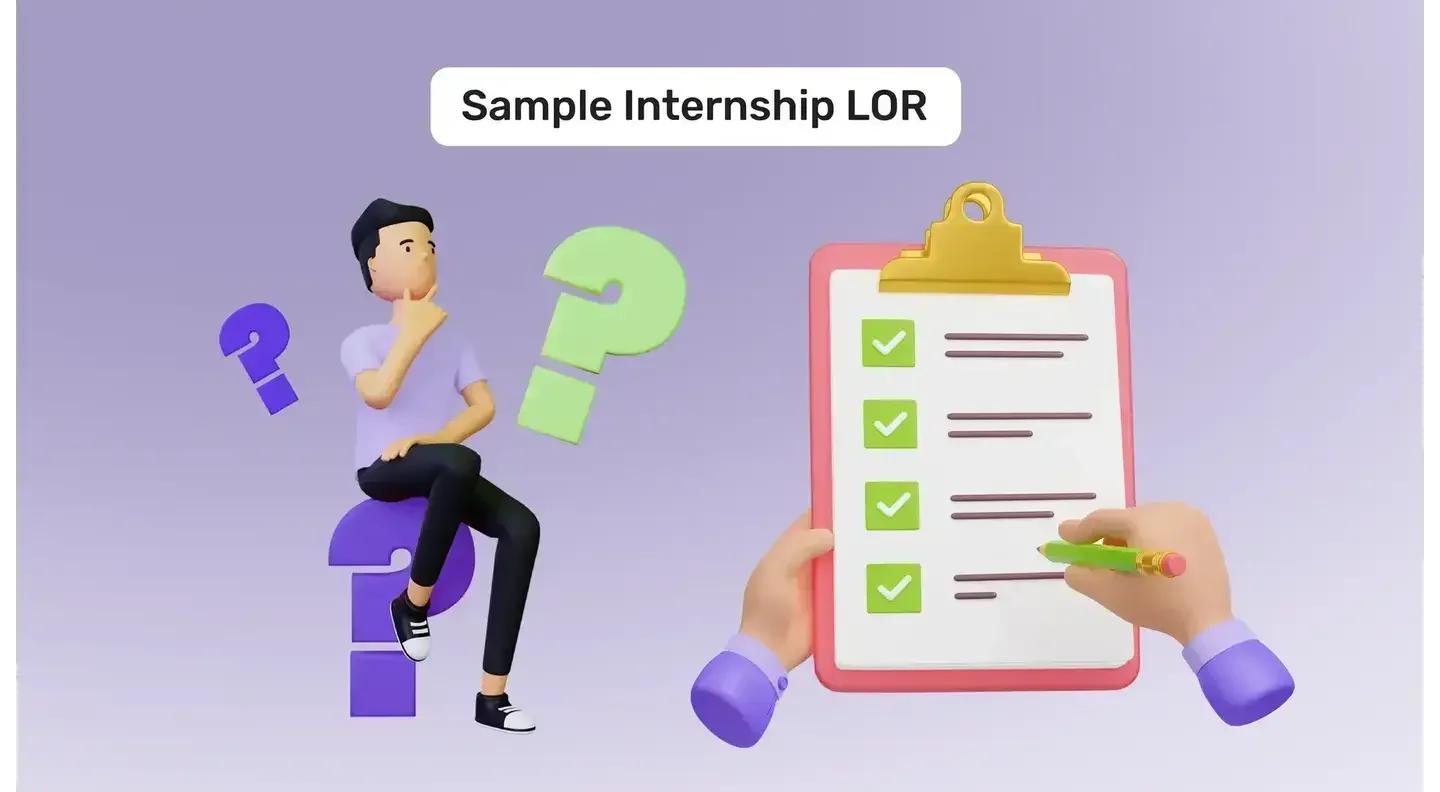
Here's a sample of an internship recommendation letter built around specificity rather than adjectives. Notice how the second version reads compared to the typical template:
To the hiring team at [Company Name],
I'm writing to recommend [Student Name] for the [Specific Internship Role] at your organization. I supervised [Student Name] during a 14-week capstone project in our department's data analytics lab from January to April 2026, and I want to share two specific observations rather than a list of qualities.
The first observation is about how [Student Name] handles being stuck. Three weeks into the project, the dataset we'd planned to use was withdrawn by the source. Most students in that situation come back with a request for an extension or a new topic. [Student Name] came back with three alternative datasets, a comparison of their limitations, and a recommendation for which one to switch to. The project finished on time because of that single decision.
The second observation is about how [Student Name] writes up technical work. The final report included a one-page summary written for a non-technical reader. When I asked why, the response was that the project would only matter if people outside the lab could act on it. That kind of thinking is unusual at the undergraduate level and is exactly what makes someone useful in a real internship environment.
I'd recommend [Student Name] for any role that requires both technical depth and the ability to communicate it clearly. Happy to answer specific questions about the work — my contact details are below.
Sincerely,
[Recommender Name]
[Designation, Institution]
[Email, Phone]
This sample is shorter than most templates online. It uses two concrete incidents instead of six adjectives. It signals what kind of role the student would fit, and it leaves the door open for a recruiter call. That last detail matters more than students realize recruiters who can verify a letter quickly are more likely to trust it.
The request process is where most students sabotage their own letters before a word is written. The fix isn't more politeness or more lead time. It's giving the recommender the raw material to write something specific.
The following table separates phrases that signal effort from phrases that signal autopilot in a letter of recommendation for an internship:
| Phrases That Hurt Credibility | Phrases That Build Credibility |
|---|---|
|
He is hardworking and dependable |
When the deadline shifted by a week, he restructured the workflow without being asked |
|
She has excellent communication skills |
She presented our findings to a 30-person review panel and handled three pushback questions cleanly |
|
He is proficient in Python, Java, C++ |
He shipped the parsing module in week 4 after we discovered the existing approach wouldn't scale |
|
She is a valuable asset to any team |
When a teammate dropped out, she absorbed two additional modules without asking for credit |
|
He has a positive attitude |
When the first prototype failed user testing, he proposed three iterations within 48 hours |
|
She will excel in this role |
She has done the closest equivalent of this internship's core task in our lab, twice |
The pattern is the same throughout: replace claims with incidents. Recruiters in 2026 trust incidents because incidents are harder to fabricate than adjectives.
This is the question students rarely ask out loud but think about constantly: does anyone actually verify a letter of recommendation for an internship?
For most domestic Indian internships, especially short-term ones, formal verification is uncommon. Recruiters skim the letter, register the signal, and move on. The volume of applications makes deep verification impractical.
For higher-stakes internships — top-tier consulting, finance, international programs, and any internship that converts to a full-time offer verification happens more often than students assume. It usually takes one of three forms: a follow-up email to the recommender's institutional address, a quick phone call to confirm the relationship, or a casual question during the interview about a specific incident mentioned in the letter.
The risk runs heavily one way. If a letter is honest and specific, no verification will ever damage you. If a letter is inflated or fabricated, even a routine follow-up exposes it. And in 2026, with hiring teams increasingly comparing applicants across multiple data sources, that exposure can quietly close doors the student never sees closing.
Students on Indian career subreddits have increasingly shared stories of internship offers getting quietly delayed or rescinded after recruiters made verification calls. One pattern recurs: the recruiter calls the professor listed on the LOR, the professor takes a few seconds too long to recall the student, and the recruiter mentally downgrades the application without telling anyone. The student never finds out why the offer stalled. They just see a longer-than-usual wait followed by a polite rejection. This is the failure mode most students underestimate, because it leaves no evidence.
The IIT Roorkee notice in March 2026 cautioning against fraudulent internship and training programmes from unauthorised external entities is part of a broader institutional pattern: educational and corporate bodies are getting more rigorous about authenticity in internship-related documentation. Casual document inflation is getting harder to get away with.
Students are already using AI for LORs. Most career blogs still pretend they aren't, so here's the direct answer.
It would be dishonest to claim that every generic LOR fails. In specific contexts, a standard template letter still clears the bar.
The internship recommendation letter has not died. What's died is the version of it that most students still submit the three-paragraph template with generic praise and senior signatures.
The version that works in 2026 is shorter, more specific, and more honestly opinionated. It uses incidents instead of adjectives. It picks recommenders who actually saw the work instead of senior names with no context. It treats the letter as evidence rather than endorsement. And it acknowledges that recruiters today have read enough AI-generated and template-driven letters to filter them out in seconds.
The most expensive mistake students make isn't writing a weak LOR. It's submitting one that's so generic it neither helps nor hurts and then assuming the recommendation system worked because the box was checked. It didn't work. The letter just got ignored.
If you're working on study-abroad applications, LORs carry even more weight than they do for internships. Admissions committees read thousands of letters per cycle and have developed even sharper instincts for generic ones. Specific beats generic. Incidents beat adjectives. Honest beats inflated. If you want a second pair of eyes on which recommenders to choose, how to brief them, and what your LORs should actually say for the universities you're targeting, book a session with a consultant.

Most internships ask for one or two. Some competitive programs ask for up to four. Always check the application requirements first, sending extra letters when only one is asked for can come across as overcompensating.
You shouldn't. Even though it happens widely in Indian colleges, recruiters in 2026 are increasingly skilled at spotting self-written letters. The risk is reputational, letters that fail an interview cross-check damage you more than no letter would.
A previous internship supervisor with specific observations of your professional behavior generally outperforms a college professor, especially for industry internships. For research internships, a faculty member who supervised relevant project work is usually better.
Yes, more than students assume. An LOR on official institutional letterhead, sent from an institutional email, is the baseline authenticity signal recruiters use in 2026. Letters from personal accounts get discounted automatically.
One page maximum. Recruiters spend under a minute on most LORs. A focused one-page letter with two specific incidents outperforms a two-page letter with general praise.
Check Your Education Loan Eligibility

Ask from a community of 10K+ peers, alumni and experts
Be the first to discuss this article
Ask a question or share your experience with students on GD Connect.
Add Your ResponseTrending Blogs
Similar Blogs

Network with a community of curious students, just like you
Join our community to make connections, find answers and future roommates..Country-Wise Loans
Best Lenders for Education Loan

ICICI Bank

Axis Bank

Union Bank

Prodigy

Auxilo

Credila

IDFC

InCred

MPower

Avanse

SBI

BOB
Poonawalla
Saraswat