



.webp)





















Help our experts understand you better by filling our 2-Minute Form, to find the right education loan
Get instant loan offer suitable to your profile !

On this Page:
Thinking about low-ranked universities in the USA? Learn the pros, risks, visa impact, job outcomes, and ROI before accepting your admission offer.

Getting into a U.S.university has never been easy, but lately, many international students are finding offers coming from institutions they hadn’t originally planned for. As admission cycles grow more competitive and visa timelines tighten, low-ranked universities in the USA are seeing a steady rise in applications and admits. For some students, these offers feel like a compromise driven by urgency; for others, they represent a practical entry point into the American education system.
This puts students in a difficult position. Accepting such offers can mean faster admits and lower entry barriers, but it also raises serious questions about academic value, career outcomes, and long-term return on investment. It is necessary to find out in what areas these universities provide the opportunity, and where they fail to meet the expectations, prior to making the decision, which can influence the following decade of your professional life.

In the U.S, a university is typically ranked as low when it is not among the top 200-300 of major international or national ranking lists, including QS World University Rankings, Times Higher Education, or U.S. News. Such institutions generally have a small international brand recognition, i.e., their names do not hold much weight beyond narrow geographical areas or local employer networks. Most are local state or small private colleges and universities that do not focus on a cohort of students across the globe.
This classification does not imply poor teaching quality by default, but it often reflects weaker research output, lower faculty citation impact, smaller endowments, and limited employer partnerships compared to higher-ranked universities. As a result, their visibility among multinational recruiters and global graduate schools remains restricted, which can directly influence career mobility for international students.
Over the last few admission cycles, U.S. universities outside the top ranking brackets have significantly increased international intake to offset declining domestic enrolments and funding pressure. According to Open Doors data, a large share of new international enrollments in the U.S. now flows into regional and lesser-known institutions, many of which operate with higher acceptance rates than top-ranked universities.
Key reasons students apply:


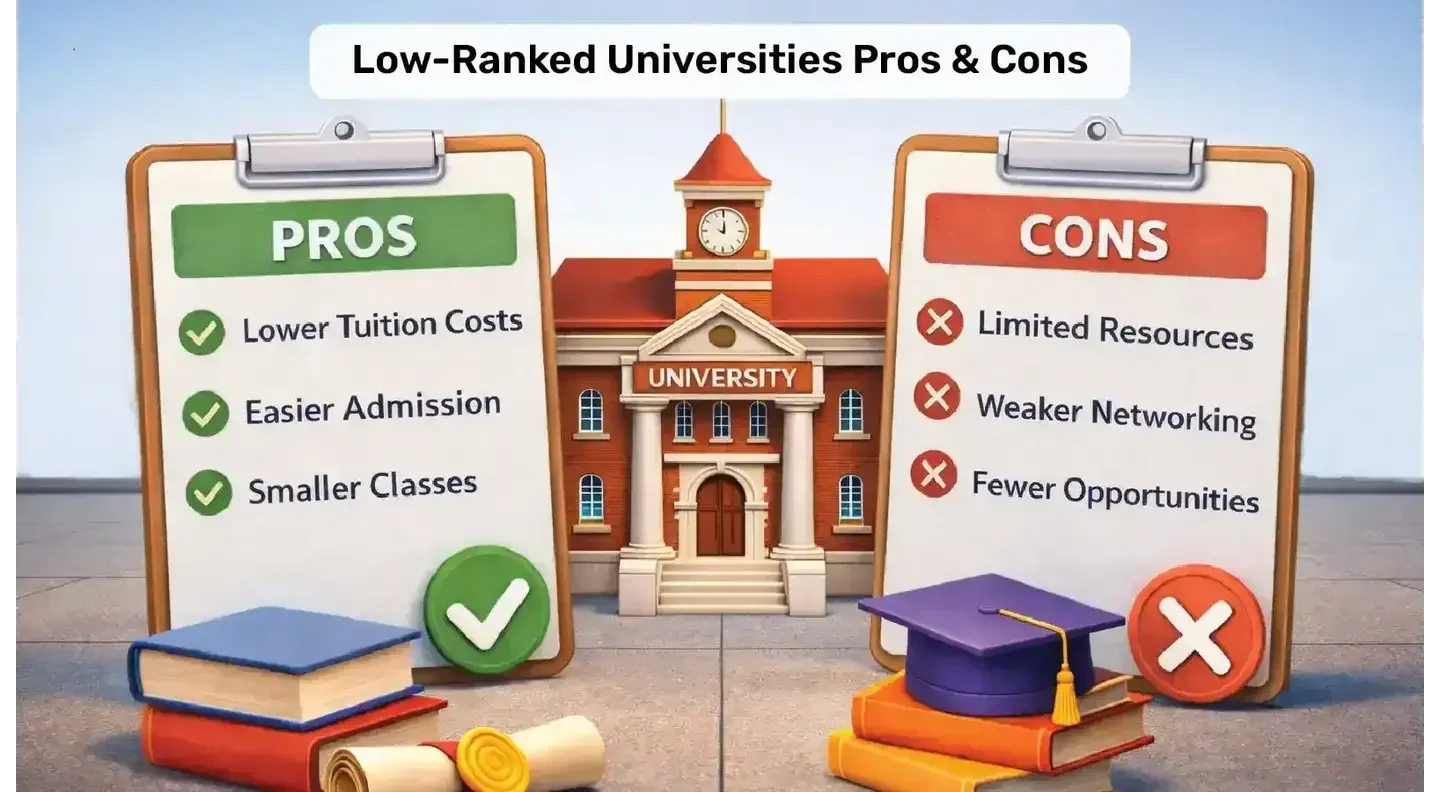
Low-ranked universities do offer practical advantages that work in favor of certain student profiles. Lower barriers of entry are one of the biggest attractions, where students who might not have the strong academic cutoffs of the best schools but have definite career ambitions can have access. This is a second chance and not a shortcut for many.
Academically, these universities often operate with smaller class sizes, especially at the graduate level. This allows for more personalised faculty interaction, easier access to academic advisors, and closer supervision on projects or coursework. In contrast to large, research-heavy universities where international students can feel anonymous, regional institutions tend to focus more on teaching delivery and student support. This environment can assist proactive students in developing stronger academic backgrounds.
Myth: The lower the rank of the university, the lower the total costs.
Reality: Base tuition may be cheaper, but the overall cost of attendance may increase because of institutional fees that are mandatory, increased health insurance, fewer campus workplaces, and longer time periods of school
Myth: Scholarships significantly reduce financial pressure.
Reality: The vast majority of scholarships in low-ranking universities are actually small tuition breaks and not full-blown financial aid. Having few endowments, the institutions can do little to finance the living costs or fund over a period.
Myth: Smaller cities always make student life cheaper.
Reality: Lower rent is often balanced out by higher transportation costs, fewer paid internships, and limited access to part-time work, which can weaken both affordability and career exposure over time.
One of the less-discussed disadvantages of studying in the USA at low-ranked universities lies in the substance of academic delivery rather than access. Teaching-intensive models of faculty are common in these institutions, with professors being assigned high course loads with little time available to conduct research, curriculum development, or work with industry partners. While this supports classroom continuity, it can restrict exposure to cutting-edge developments in the field.
From a curriculum standpoint, many programs are slow to adapt to changing industry requirements, especially in fast-evolving areas like data science, AI, or business analytics. Reduced research funding and less doctoral training also imply that there are fewer opportunities for students to engage in funded projects, publish papers, and receive a more advanced level of methodological training. This lack of depth in an academic program can be a permanent limitation to the student who wants to take a research-focused career path or an internationally competitive job, instead of a temporary trade-off.
Low-ranking university graduates in the USA tend to have fewer on-campus placement options, and the majority of recruiters are local or region-based. Large employers and visa-sponsoring firms rarely prioritise these campuses, forcing students to rely on off-campus job searches almost immediately after graduation.
This makes employment outcomes highly network-dependent. Referrals, personal outreach, and short-term roles become essential, even for capable candidates. In the absence of powerful institutional branding or employer pipelines, the process of translating a degree into a stable job may not be easily achieved, particularly on a tight visa schedule.
One of the most serious disadvantages of studying in the USA at low-ranked universities surfaces during OPT and visa processing. Although there are numerous programs that claim to provide a STEM designation, not all of them are equally recognized by employers or immigration agencies. Degrees of institutions with a smaller niche have a higher risk of further scrutiny, which can lead to delays or Requests for Evidence (RFEs) when extending OPT or filing H-1B.
There is further difficulty brought about by employer reluctance. Companies tend to be wary of sponsoring candidates from a school with minimal academic or industrial reputation, which reduces the scope of potential employment. Such difficulties may result in missed OPT schedules, compelled career transformations, uncompensated waits, or premature departures out of the U.S., regardless of the academic qualifications of such students.
The usefulness of an alumni network in the long run is determined by how far and how strong the network reaches, and in this regard, low-ranked universities usually fail. The vast majority of alumni networks are still regionally based, providing benefits only within local employment sectors, as opposed to across industries or nations.
This constrained reach limits access to referral, mentorship, and transboundary career opportunities to international students who are interested in global mobility. In the absence of a robust or visible alumni presence in major industries, networking initiatives will be more individualistic, deteriorating the long-term value of the degree.
Most overseas students are dependent on huge education loans supported by co-signers in their families, placing households under long-term financial obligations when it remains uncertain. Repayment pressure starts at an early age, even in months after graduating, when the post-study income fails to increase accordingly.
This risk is compounded by the stalling of job changes or the position being out of the anticipated salary range. When this occurs, students could be subjected to long repayment terms, an increase in interest rates, or reliance on family. In comparison to a degree earned in high-ranking institutions with fairly consistent placement pipelines, the eventual payoff in this case is extremely unpredictable, which is why financial planning becomes flimsy instead of being strategic.
This path does not suit everyone, but it’s workable. Low-ranked universities in the USA tend to benefit students who enter with leverage, not those starting from scratch. Those individuals who have prior work experience, good technical background, or fit between role and purpose are not as dependent on institutional branding as a gateway to opportunity.
Limited campus support can be offset by students who are comfortable with self-networking by referral, direct outreach, and independent job searches. This also extends to applicants, whose skills are either niche or high-demand, with employability being less competency-led than reputation-led by the university.
Fresh graduates with no prior work experience are especially vulnerable, as they rely heavily on campus placements, brand recognition, and employer trust, all areas where these institutions tend to be weaker. Students who intend to borrow big education loans need to exercise caution as well. Without predictable job outcomes, high repayment obligations can quickly become unmanageable. Similarly, non-STEM aspirants face narrower job markets and shorter OPT windows, making recovery from weak placements significantly harder. In these cases, the structural disadvantages often outweigh the potential benefits.
While both categories fall outside elite university brackets, the gap between low-ranked and Tier 2 universities becomes clear when outcomes, employer access, and risk exposure are compared side by side. For students deciding between the two, understanding these differences is critical for realistic planning.
| Factor | Low-Ranked Universities | Tier 2 Universities |
|---|---|---|
|
Average tuition fees |
$6,000 to $20,000 |
$20,000 to $40,000 |
|
Outcome predictability |
Success depends largely on individual effort |
More consistent outcomes with clearer placement patterns |
|
Employer access |
Restricted to regional or smaller employers |
Wider access to mid-sized and large recruiters |
|
Campus placements |
Irregular or minimal on-campus hiring |
Structured career services with recurring recruiters |
|
Visa & OPT safety |
Higher scrutiny |
Relatively safer due to program credibility and employer familiarity |
|
Alumni leverage |
Regionally limited influence |
Broader alumni presence across industries |
|
Overall risk level |
High uncertainty |
Moderate, more manageable risk |
Choosing a low-ranked university in the U.S. is possible, but risky without a clear strategy. These institutions can work for students who enter with experience, strong self-networking ability, and realistic expectations. For everyone else, the margin for error is thin. Weak employer access, visa sensitivity, and uncertain returns can quickly outweigh the initial ease of admission. Long-term career planning rather than short-term convenience should be the motivating factor behind the decision.
In case you are willing to take this step, consider the financial risk. Before committing, check your education loan eligibility with GyanDhan to understand repayment feasibility and avoid over-leveraging yourself at the start of your journey.
Use this checklist to minimize the risk and prevent irreversible errors before accepting an offer at a low-ranked university in the USA:

Students have the tendency of leaving America because of job insecurity upon graduation or because they are unable to find an employer willing to sponsor their visa, or they have problems with OPT and visas. Financial stress, particularly repayment of loans without earning a regular salary, is another key factor, as well as a lack of career advancement in some professions or personal considerations.
Yes, but it’s not automatic. The results of the job are based on your university, major, skills, networking skills, and the time of your visa. Some students do well while others struggle despite having a degree.
Indirectly, yes. Lower-ranked institutions can face more scrutiny during OPT or H-1B filings.
Check Your Education Loan Eligibility

Ask from a community of 10K+ peers, alumni and experts
Be the first to discuss this article
Ask a question or share your experience with students on GD Connect.
Add Your ResponseTrending Blogs
Similar Blogs

Network with a community of curious students, just like you
Join our community to make connections, find answers and future roommates..Country-Wise Loans
Best Lenders for Education Loan

ICICI Bank

Axis Bank

Union Bank

Prodigy

Auxilo

Credila

IDFC

InCred

MPower

Avanse

SBI

BOB

Poonawalla

Saraswat