




.webp)









._Abroad_vs_MS_vs_Job_blog_19_sep_2024-01_0310d2a88e93352b56f0.webp)









.webp)


Help our experts understand you better by filling our 2-Minute Form, to find the right education loan
Get instant loan offer suitable to your profile !

On this Page:
Compare MBA in USA vs MBA in Europe based on cost, ROI, salaries, visas, loans, and career outcomes. Find the best option for your goals.

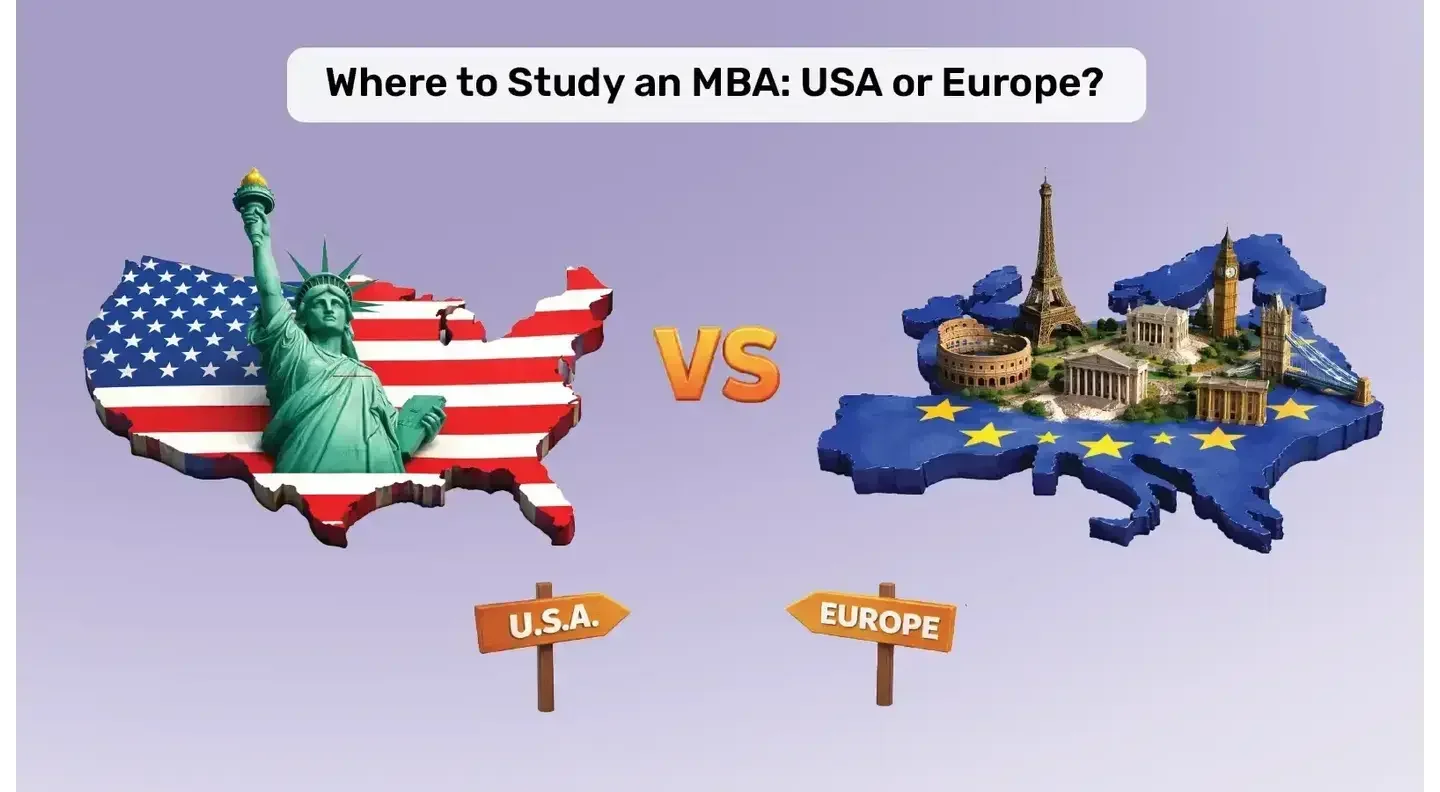
For most MBA applicants, the real question is no longer whether to study abroad, but where the trade-offs make sense. Comparing an MBA in the USA vs MBA in Europe now involves balancing ranking power against cost efficiency, program length, and post-MBA mobility. American schools are still leading world league tables due to extensive corporate penetration and high pay performance. Europe, however, has gained traction through accelerated formats like the one-year MBA in Europe, which cuts tuition exposure and opportunity cost almost in half. With visa pathways tightening and education loans rising, this choice has become a strategic investment decision rather than a prestige-driven one.

The way an MBA is taught often matters more than what is taught. The MBA in the US centers its learning around leadership, high-speed classroom discussions, and case-based education based on real-life business scenarios. Students are expected to speak up, take ownership of decisions, and think like founders or senior managers early on.
MBA programs in Europe follow a different path. In very globalized cohorts, the emphasis is on global exposure, consulting-type problem solving, and business models based on sustainability. This strategy reflects the focus on cross-border management, policy sensitivity, and value creation across time that is prevalent in Europe as opposed to short-term scale.
Comparing MBA programs among different regions, some of the structural differences often directly influence cost, learning outcomes, and return on investment. The following table demonstrates the difference between core factors in business schools in the USA and Europe, and can allow an applicant to evaluate fit beyond rankings alone.
| Factor | MBA in the USA | MBA in Europe |
|---|---|---|
|
Program Duration |
2 years |
12-18 months |
|
Return on Investment (ROI) |
Higher post-MBA salaries but longer break from employment increases opportunity cost |
Shorter duration reduces tuition exposure and opportunity cost, improving early ROI |
|
Class Profile |
Students from diverse industries with strong leadership or managerial backgrounds |
Highly multicultural cohorts with significant international and cross-border experience |
|
Learning Style |
Leadership discussions, teamwork, and competitive classroom dynamics |
Global perspectives, collaborative problem-solving, and cultural intelligence |
|
GMAT Expectations |
680 to 740 for competitive and top-tier schools |
Typically 600 to 700, with flexibility for strong global profiles |
|
Work Experience |
4-6 years commonly preferred |
Quality and global exposure valued |
|
Tuition & Living Costs |
USD 120,000 to 160,000 |
EUR 60,000 to 100,000 |

Funding an MBA is not often restricted to tuition, and therefore, scholarships and financial support constitute a significant component of the decision-making process. In the MBA in the US, funding is primarily driven by a mix of merit-based and need-based aid, often awarded directly by business schools based on academic profile, leadership potential, and career impact. European MBA programs are more inclined toward a fragmented yet varied model. Besides school-level scholarships, various countries have government-sponsored or region-based funding, especially among international students, which reduces the overall cost burden.
| Funding Type | USA | Europe |
|---|---|---|
|
Merit-Based Scholarships |
Harvard Business School Fellowships, Stanford GSB Scholarships, Wharton Fellowships |
INSEAD Scholarships, London Business School Fund Scholarships, HEC Paris Excellence Scholarships |
|
Need-Based Aid |
HBS Need-Based Fellowships, Stanford GSB Need-Based Aid |
Limited; primarily school-specific rather than universal |
|
Government / Regional Scholarships |
Limited federal support for international students |
Eiffel Excellence Scholarship (France), DAAD Scholarships (Germany), Chevening Scholarships (UK) |
|
Corporate / External Funding |
Forte Fellowship, Consortium Fellowship |
Erasmus+ (select programs), country-specific mobility grants |
The fee structures differ across regions and levels of institutions. In the USA, increased tuition and living expenses tend to increase loan amounts, and thus repayment periods and interest coverage become the most important factors. European MBA programs, with shorter durations and lower overall costs, typically require smaller loan amounts, which improves approval feasibility and reduces long-term financial pressure.
| Institution Tier | USA: Avg. Tuition + Living Cost | Europe: Avg. Tuition + Living Cost | Loan Implication |
|---|---|---|---|
|
Tier 1 Universities |
USD 130,000 to 160,000 |
EUR 90,000 to 110,000 |
|
|
Mid / Average Universities |
USD 90,000 to 120,000 |
EUR 60,000 to 80,000 |
Europe generally needs lower loan cover, improving approval odds |
|
Emerging Universities |
USD 70,000 to 90,000 |
EUR 45,000 to 65,000 |
Smaller ticket size in Europe reduces EMI burden and collateral dependency |
Financing, feasibility-wise, the USA requires better credit profiles and greater repayment capability because of greater loan amounts. Europe, by contrast, benefits from lower ticket requirements and shorter program durations, making education loans more manageable for a broader range of applicants.
Regional differences tend to be the most obvious in career switching. In an MBA in the USA vs MBA in Europe comparison, the American model places strong emphasis on summer internships, typically completed between the first and second year. According to the GMAC Corporate Recruiters Survey 2024-2025, internships remain the primary conversion route into full-time roles across consulting, finance, and technology in the U.S. Employment reports from schools such as Harvard, Wharton, and Stanford show that in 2025, median post-MBA base salaries at top American programs ranged between USD 160,000 to 185,000, reflecting both strong demand and high competition.
European MBA programs follow a different structure. With shorter course durations, internships are less common, and hiring is more placement-led. According to the Financial Times Global MBA Rankings 2025 and the reports on employment by INSEAD and London Business School, consulting still reigns in European MBA hiring. Median salaries in 2025 typically ranged from EUR 85,000 to 120,000, supported by structured recruitment cycles and cross-border roles. Pay levels might be lower, but entry into the workforce and the opportunity cost are more important in general career returns.
Immigration policy is an important component in the long-lasting planning process in comparison of MBA in the USA vs MBA in Europe. In the USA, international MBA graduates typically rely on F-1 OPT, with a standard 12-month work authorization. While STEM-designated Although the STEM-designated MBA courses could have an option of an extra 24 months, the long-term location is subject to H-1B visa availability, which is still a lottery and is not guaranteed. This adds risk for those planning extended careers in the MBA in the US market.
European MBA tracks are more predictable in general. Most MBAs in European countries offer post-study residence permits ranging from 12 to 24 months, followed by clear routes to long-term work permits and permanent residency. Germany, France, and the Netherlands are some of the countries that have organized PR plans according to the length of employment, and hence, Europe is a more secure investment among applicants who are concerned with long-term settlement and mobility.
Network strength and entrepreneurial outcomes tend to go hand in hand when making MBA decisions. With the MBA in the US, learners get the advantage of first-hand exposure to global startup hubs and venture capital ecosystems, with business schools serving as a gateway to accelerators, investors, and early-stage funding. This strength is supported by strong alumni networks that are actively involved in hiring, mentorship, and fundraising in industries and geographies. European MBA programs are also known to possess good entrepreneurial ecology, especially in cities such as London, Berlin, and Paris; the regulatory environments and region-specific frameworks may cause slow early scaling. Networking in Europe tends to be more regional and industry-specific, favouring deep connections within consulting, finance, and multinational firms rather than a broad global reach.
In the USA, graduates often see a 60 to 100% salary jump post-MBA, but this comes with higher upfront costs and longer payback periods, making outcomes more sensitive to job conversion and visa success. Europe offers a more effective ROI curve, with salary growth rates usually ranging between 40 to 70%, which is backed up by reduced total expenditure and quicker workforce re-entry. Earnings can be lower, however, with less financial exposure and more predictable recovery periods, Europe becomes a safer and more predictable investment, among many candidates.
Campus life in the USA has been characterized as hectic and performance-oriented, with excessive workloads, frequent recruitment events, and a focus on individual performance. The rhythm of European MBA programs is more balanced in general; the academic intensity is mixed with the cultural immersion. Residing in an old city, a multilingual setting, and work-life delineation tend to be appealing to students who enjoy the depth of culture, as well as their professional development.
An MBA in the US is best suited to cater to candidates who seek an aggressive career shift and long-term upside to earnings. Professionals looking to switch industries, move into leadership-heavy roles, or build venture-backed startups benefit from the structured internship pipeline and deep corporate access. This path works well for applicants who can absorb higher financial risk and thrive in competitive, performance-driven environments where salary growth is closely tied to outcomes.
An MBA in European countries appeals to candidates targeting global careers with faster financial recovery. Europe has varied cohorts and systematic models of hiring, which often prove useful to those interested in consulting, cross-border positions, or multinational companies. Europe, with shorter courses and fewer overall expenses, is better placed to meet the needs of professionals who want an effective ROI, cultural exposure, and a better understanding of the post-study mobility without spending much time out of the workforce.
Students tend to make MBA decisions with heavy pre-conceived ideas in mind without doubting whether the ideas continue to be relevant in the modern global job market.
Myth: A US MBA is always better.
Reality: Outcomes depend on role, industry, and visa conversion. Many European MBA graduates achieve comparable career growth with lower financial exposure.
Myth: Europe limits long-term career growth.
Reality: Europe has good consulting, financial, and multinational company advancement, with better international mobility.
Myth: Shorter programs mean weaker learning.
Reality: Accelerated European MBAs are time-compressed by nature and professional-oriented.
Myth: Lower fees mean lower quality.
Reality: Several European schools consistently rank among global leaders despite significantly lower total costs.
There is no universal winner in the MBA in the USA vs MBA in Europe decision. The best option is one that best fits your career aspirations in terms of overall cost, size of the loan, and the potential post-MBA income. A U.S. MBA can justify higher investment for candidates targeting steep salary growth, but it also involves larger education loans and longer repayment horizons. Europe offers a more controlled financial path, with lower borrowing needs and faster recovery. Before committing, it’s important to calculate how much funding you’ll actually need, what your repayment could look like, and whether projected salaries can support it. This is where a loan-focused evaluation by GyanDhan helps students add clarity before the decision becomes irreversible.

No single best country exists because it is all a matter of objectives. France and the UK are good in terms of consulting and global exposure, Germany is good in terms of operations and industry positions, and Spain and Ireland are good in terms of students favoring a balance between cost and international careers.
Some of the most popular schools in the world are located in Europe, such as the INSEAD, London Business School, HEC Paris, IE Business School, and IESE Business School. Such institutions are characterized by high employer relationships, varied cohorts, and consistent placement results.
GMAT is essential, though not conclusive. European schools are more flexible, and they also believe in work experience, international exposure, and the strength of the profile as well.
Consulting, finance, strategy, sustainability, and international management are among the most common MBA focus areas across European business schools.
Check Your Education Loan Eligibility

Ask from a community of 10K+ peers, alumni and experts
Be the first to discuss this article
Ask a question or share your experience with students on GD Connect.
Add Your ResponseTrending Blogs
Similar Blogs

Network with a community of curious students, just like you
Join our community to make connections, find answers and future roommates..Country-Wise Loans
Best Lenders for Education Loan

ICICI Bank

Axis Bank

Union Bank

Prodigy

Auxilo

Credila

IDFC

InCred

MPower

Avanse

SBI

BOB

Poonawalla

Saraswat