



.webp)


















Help our experts understand you better by filling our 2-Minute Form, to find the right education loan
Get instant loan offer suitable to your profile !

On this Page:
Explore the best Tier 2 universities in the USA for 2026. Compare costs, acceptance rates, locations, job outcomes & ROI for Indian students.

Quick Summary:
| What changed | What it means for you |
|---|---|
|
No U.S. government body has ever officially classified universities into tiers. |
The tier 2 label you keep seeing is consultant and forum shorthand, not policy. |
|
DHS logged 1,582,808 active F-1 and M-1 students in calendar 2024, with India up 11.8 percent to 422,335. |
Indian enrollment is growing fastest even as total school certifications shrink. |
|
A new DHS rule replaces the H-1B random lottery with a wage-weighted one from February 27, 2026. |
Your job offer's wage level, not your university's name, decides your visa odds now. |
|
The widely feared 100,000 dollar H-1B fee mostly does not apply to F-1 to H-1B change of status. |
Most Indian OPT to H-1B transitions inside the US are exempt, contrary to what circulates on forums. |
|
Indian banks have no official rulebook for ranking foreign universities either. |
Loan amount and collateral terms for the same tier of school can vary bank to bank. |
|
GyanDhan has structured loans for 35,000+ students across 11,000+ crore in financing, through a network of 1,800+ partner banks and universities. |
That volume gives a pattern of which tier 2 bets actually pay off, and which don't. |
There is no official register anywhere in the U.S. federal system that sorts colleges into tier 1, tier 2, or tier 3. Not at the Department of Education, not at the National Center for Education Statistics, not in the Federal Register. What the government does track, in granular detail, is who actually enrolls where, what they earn afterward, and now, thanks to a rule that just cleared the Federal Register in December 2025, what wage level their first job offer needs to hit to win an H-1B. That last part is new for 2026, and it changes the math on choosing a tier 2 university in the USA in a way most admission guides have not caught up to yet.

Ask three counselors what makes a school tier 2 and you will get three different cutoffs, usually built off QS or US News bands. That is fine as shorthand, but it means every list of tier 2 colleges in the USA you read online, including the one this page used to carry, is really just one person's opinion dressed up as a category. The government does not participate in this exercise at all. The closest thing to an official classification is the Carnegie Classification system, now run by the American Council on Education, and even that sorts schools by research output (R1, R2, R3), not by prestige or selectivity. It is a different axis entirely.
This matters because when a term has no legal or regulatory definition, lenders, students, and even universities themselves end up applying it inconsistently. That inconsistency is exactly where the real risk sits for anyone taking a loan against the assumption that tier 2 means something fixed and safe.
With admissions at top schools getting tighter every year, more Indian students are looking at tier 2 universities in the USA for practical reasons.

The DHS data supports the trend. Indian student numbers are rising fast, and a large share of those students are spreading across exactly these schools.

Two federal datasets do the job that tier lists pretend to do, and they are both public.
Put those two together and you get a genuinely useful reframe: instead of asking whether a school is best tier 2 universities in the USA material, ask what its SEVIS enrollment trend and Scorecard earnings actually show for your specific program. That is public data. A tier label is somebody's guess.
For many students, affordable tier 2 universities in the USA are a financially strategic choice rather than a compromise. The main advantage is simple: lower cost means a smaller loan and a shorter repayment period. This is a major reason tier 2 universities in the USA for Indian students stay in demand.
| Cost Factor | Tier 1 Universities in the USA | Tier 2 Colleges in the USA |
|---|---|---|
|
Tuition |
USD 59,000 to 71,000 at the top-ranked ones |
USD 25,000 to 32,000 at public schools |
|
Living Costs |
Often in high-cost cities like New York, Boston, or San Francisco |
Frequently in mid-sized or more affordable cities |
|
Assistantships |
Highly competitive due to large applicant pools |
More accessible, since applicant pools are smaller |
|
Scholarships for International Students |
Limited and merit heavy |
Moderate availability with profile based consideration |
|
Loan Dependency |
Higher loan requirement and longer repayment |
Lower loan exposure and faster break-even |
Here is the part most tier 2 universities in the USA for MS content have missed entirely, because it only became final in the last few weeks of 2025.
That second policy is the presidential proclamation from September 19, 2025, requiring a 100,000 dollar payment on certain new H-1B petitions, effective September 21, 2025. It caused genuine panic, and a lot of that panic was based on an incomplete reading of the rule.
USCIS clarified within a month, on October 20, 2025, that the fee applies only to new H-1B petitions filed for beneficiaries who are outside the United States and do not already hold a valid H-1B visa. It does not apply to change of status petitions filed for someone already inside the US, which is exactly the path most Indian students take when they move from F-1 OPT or STEM OPT into H-1B employment without leaving the country. Extensions, amendments, and change-of-employer filings for people already in the US are also exempt. In practice, this means the overwhelming majority of Indian students transitioning from OPT to H-1B through their current US employer are not the ones this fee targets.
The weighted lottery is the change that actually reaches ordinary OPT to H-1B transitions. The 100,000 dollar fee mostly reaches new hires being brought in from abroad. Conflating the two, which happens constantly in comment sections, leads students to either panic about the wrong thing or dismiss the rule that genuinely affects them.
Job outcomes from tier 2 universities in the USA are shaped far more by skills, location, and effort than by the university brand. Most graduates do not rely on large on-campus placement drives. Recruitment usually comes through mid-sized companies, local tech firms, consulting roles, startups, and state employers. On-campus recruitment exists but is often program-specific and small in scale.
Many students secure roles off campus through internships, networking, referrals, and a steady job search during OPT. This matters most for applicants at tier 2 universities in the USA for MS programs, where employability depends on the program pipeline rather than the ranking. Schools such as San Jose State University, University of Cincinnati, and University at Buffalo are known for graduates who work at major companies, largely because of location and strong co-op or internship links.
There is one 2026 change worth adding here. Under the new weighted H-1B lottery, your visa odds now depend on the wage level of your job offer, which is influenced more by your employer and role than by your university. This makes the type of employer pipeline your program feeds into more important than ever. A graduate hired directly by a company at a higher wage band now has better odds than one placed through a staffing firm at an entry-level wage.
The location of a university directly affects internship access, part-time work, and employer visibility. A tier 2 school inside a major industry cluster often gives more practical exposure than a higher-ranked campus that is geographically remote. This is why many mid tier universities in the USA outperform their ranking on employment outcomes.
San Jose State University is the clear example, since its position next to Silicon Valley gives students access to startups, mid-sized tech firms, and contract roles. Texas and Midwestern schools benefit in the same way from local tech, manufacturing, and healthcare ecosystems. This geographic advantage lowers the dependence on narrow on-campus recruitment and lets students build experience throughout their degree, which makes location a more reliable signal of employability than ranking.
You would expect banks financing these loans to have their own tiering system by now. They mostly don't, at least not one that is written down or standardized. The IBA Model Education Loan Scheme, framed with RBI's backing, explicitly leaves it to individual banks to factor in institute reputation, placement history, and course type when deciding loan quantum and whether collateral is waived above the base threshold. That is bank discretion, not a published rulebook. Two students headed to schools of comparable standing can walk away with different loan ceilings depending on which bank's internal team reviewed the file.
Compare that to how the same government treats domestic institutions. The PM-Vidyalaxmi scheme, run by the Department of Higher Education, maintains an actual published list, now at roughly 904 to 917 Quality Higher Education Institutions, built directly off NIRF rankings and updated annually, to decide who gets collateral-free, guarantor-free loans. For a student staying in India, there is an official list. For a student going abroad, there is none. That gap is exactly why loan terms for affordable Tier 2 universities in the USA feel inconsistent from one bank to the next: there is no equivalent NIRF for foreign schools, so every lender is improvising.
Given all of this, the checklist worth using looks different from a rankings comparison.
Program to employer pipeline, not just program reputation. Ask directly, before applying, what share of recent graduates were hired by the employer's own recruiting team versus placed through a staffing partner. This now maps almost directly onto H-1B wage level odds.
Wage data for the specific program and location, pulled from the College Scorecard field of study files, not the institution average. Two departments at the same school can show very different post-graduation earnings.
SEVIS enrollment trend for the school, since a shrinking pool of certified schools combined with rising Indian enrollment means demand is concentrating, and program capacity or advising quality can suffer at schools that grow fast without matching investment.
Bank-specific loan terms, checked before you commit to a school, not after. Since there is no official foreign-university tier list guiding Indian lenders, the loan amount and collateral requirement you are quoted for a given school is a data point in itself. If one lender balks at collateral-free terms for a school another lender readily finances, that discrepancy is worth investigating rather than ignoring.
This section highlights a curated list of tier 2 colleges in the USA that balance academic quality, realistic admissions, and career outcomes, helping students identify options that make sense beyond rankings alone.
| University | Commonly cited as | Scorecard median earnings, 10 years after enrollment | What actually drives the number |
|---|---|---|---|
|
Tier 2 |
$78,988 |
Silicon Valley location feeding direct hires at Apple, Intuit, PayPal, and IBM, at a public-school net price |
|
|
Tier 2 |
$68,227 |
Strong STEM and business programs plugged into the Dallas tech corridor |
|
|
Tier 2 |
$70,814 |
Broad public research base, low fees, and strong graduate employment outcomes |
|
|
Tier 2 |
$92,538 |
Its co-op model routes students into direct employer hires, though its sub-7 percent acceptance rate means it is no longer selective like a tier 2 school |
|
|
Tier 2 |
$68,740 |
Urban campus tied to a large healthcare and engineering ecosystem, with computer science graduates earning well above the institution median |
|
|
Tier 2 |
$54,810 |
One of the oldest mandatory co-op programs in the country, feeding direct hires at employers like Procter and Gamble and GE |
|
|
Tier 2 |
$52,600 |
Large public research base with broad engineering and business programs |
|
|
Tier 2 |
$43,800 |
Applied engineering and aerospace focus with strong industry co-op links and one of the lowest costs on this list |
Two things are worth reading off this table. First, the earnings spread across schools that all get called tier 2 is wide, from the low $40,000s to the low $90,000s, which is the clearest evidence that the label itself carries little information. Second, the schools at the top of the range share a trait that has nothing to do with prestige: a structural pipeline into direct employer hires, usually through co-op or location. That is the same trait that now helps under the 2026 weighted H-1B lottery.
The key difference between tier 2 universities in the USA and tier 3 institutions is consistency and outcomes. Tier 2 colleges usually offer accredited programs, stable faculty, and measurable graduate results, even without strong global branding. They hold a reliable standard of academic quality, employer acceptance, and post-study opportunities that support long-term career planning.
Tier 3 institutions often fall short on employer outreach, industry focus, and academic rigor. Since tiers are not officially defined, the line to draw is outcome visibility. Vague placement records, few alumni, and limited internship access point toward tier 3. Any reliable list of tier 2 universities in the USA, by contrast, shows steady hiring pipelines, regional employer trust, and a transparent academic structure.
Choosing a program based on the school's overall brand rather than that specific department's placement pipeline is the single biggest one, and it is now more costly than before given the wage-weighted lottery.
None of this means avoiding tier 2 schools. It means the label was never the thing that mattered, and in 2026 that gap between label and reality has gotten more expensive to ignore, since it now touches your visa odds directly, not just your resume. Across the 35,000+ students GyanDhan has helped structure study-abroad financing for, spanning 11,000+ crore in loans and a network of 1,800+ partner banks and universities, the pattern holds: students who checked the actual placement pipeline and wage data before committing did better than students who trusted a label.
If you are shortlisting a school right now and want to see how a specific lender will treat it, check your loan eligibility before you finalize your list, or talk to a consultant about the specific program's placement history.

No. No US government agency publishes one. Rankings organizations and education consultants create their own informal bands, and definitions vary between them.
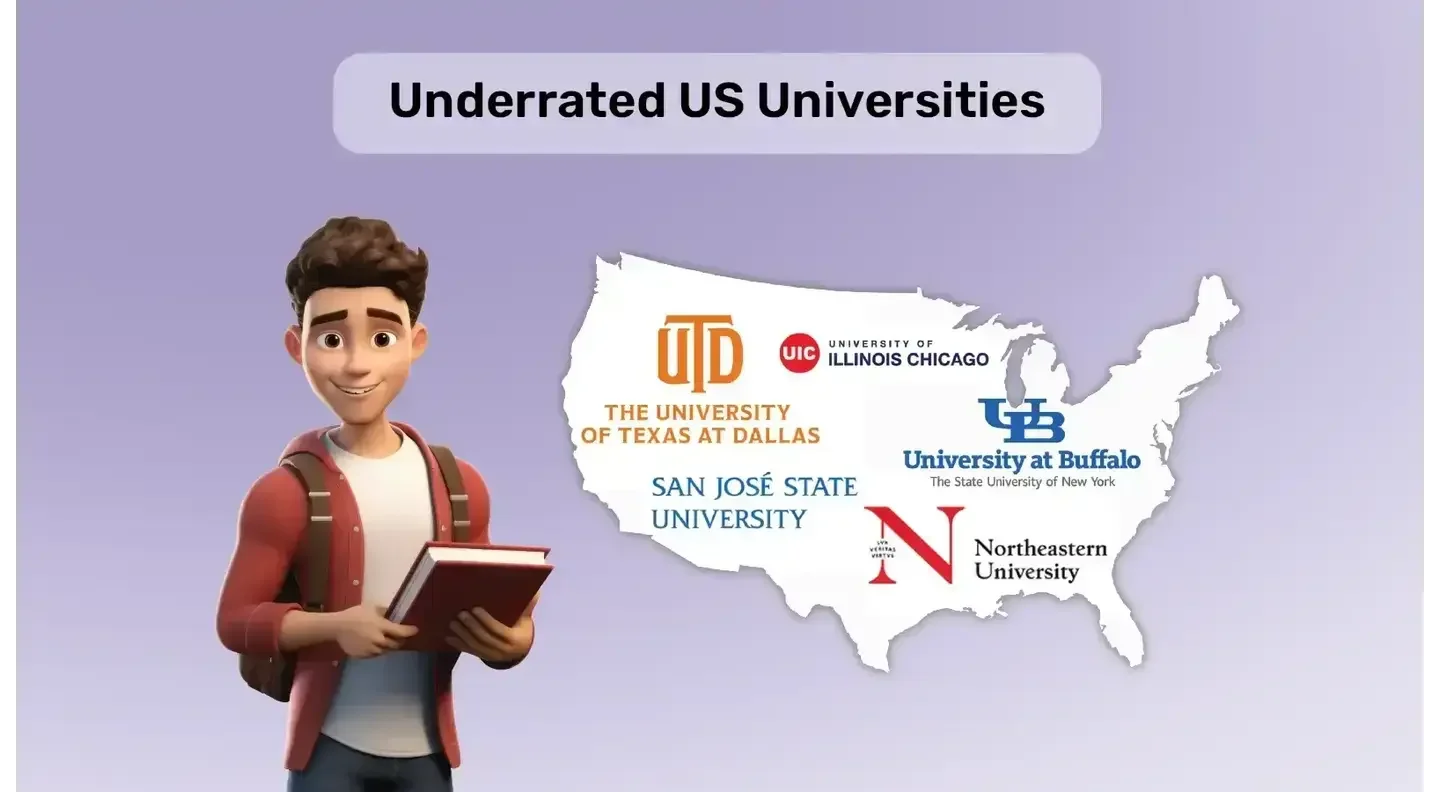
There is no official ranking, so any list is shorthand. Schools that come up often and hold up on federal earnings data include San Jose State University, University of Texas at Dallas, and University at Buffalo. Judge each one on its College Scorecard earnings for your program, not on the tier label.
In most cases yes, especially at public schools. Lower cost usually means a smaller loan and a shorter repayment period. Confirm the current figure on the College Scorecard and the university fee page before you borrow.
Yes, indirectly. The weighted lottery applies whenever your employer registers you for the H-1B cap, regardless of whether you are transitioning from OPT inside the US or being hired from abroad. What determines your odds is the wage level tied to your job offer, not your location at filing.
For a masters, the program pipeline and location matter more than the school name. Schools with strong STEM and co-op links, such as San Jose State University, University of Texas at Dallas, and University of Cincinnati, tend to serve MS applicants well. Check the field-of-study earnings for your exact program on the College Scorecard.
For most students changing status while remaining inside the United States, no. USCIS clarified in October 2025 that the fee targets new petitions for beneficiaries outside the US who do not already hold a valid H-1B visa.
No. Loan quantum and collateral requirements are set at each bank's discretion under the IBA Model Education Loan Scheme, since there is no official foreign university ranking system banks are required to follow.
Not directly. Your odds now depend on the wage level of your specific job offer, which is influenced more by your employer and role than your university's informal tier. A tier 2 graduate hired directly by a company at a Level III wage has better odds than a tier 1 graduate placed through a staffing firm at Level I.
Yes. OPT eligibility is set by federal rule and applies the same way across accredited schools, so it does not depend on any tier. Internship access depends more on program design and location than on ranking.
Check Your Education Loan Eligibility

Ask from a community of 10K+ peers, alumni and experts
Be the first to discuss this article
Ask a question or share your experience with students on GD Connect.
Add Your ResponseTrending Blogs
Similar Blogs

Network with a community of curious students, just like you
Join our community to make connections, find answers and future roommates..Country-Wise Loans
Best Lenders for Education Loan

ICICI Bank

Axis Bank

Union Bank

Prodigy

Auxilo

Credila

IDFC

InCred

MPower

Avanse

SBI

BOB

Poonawalla

Saraswat