



.webp)



















Help our experts understand you better by filling our 2-Minute Form, to find the right education loan
Get instant loan offer suitable to your profile !


On this Page:
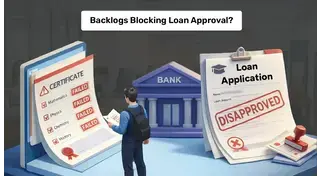
Worried about backlogs? Learn how to study in the USA with backlogs, backlog limits, MS admissions strategy, SOP tips, visa impact & university acceptance.

When most Indian students hear the term' backlog,' their minds go into a frenzy of panic, filled with missed opportunities, rejected applications, and an uncertain future. Social stigma about failing a subject in college can be very embarrassing, although it is much more prevalent than many care to acknowledge. What few people discuss is that a single or two poor grades do not determine your intelligence, discipline, or potential in the long run. What often surprises students is that backlogs are not treated as moral or intellectual failures in the US system. In that context, a rough semester becomes a data point, not a verdict. That’s why studying in the USA with backlogs is not an impossible dream, but it’s a misunderstood one.

Backlog in the Indian education system means a subject that a student failed in but has to write later, by way of re-examination. They are commonly treated as a set of rigid signs of academic vulnerability, and much attention is paid to the number of failed papers instead of the improvement in general. This perception leads many students to believe that even a few backlogs can block their chances to study in the USA with backlogs.
Contrastingly, US universities use a credit-based evaluation system. The primary concern is whether credits are ultimately completed and how a student progresses academically over time. Performance in later semesters, subject relevance, and course completion matter more than when a setback occurred. Because of this, backlog acceptance in USA universities depends less on raw numbers and more on learning outcomes, particularly for applicants planning an MS in the USA with backlogs.
A common myth is that US universities have a strict backlog limit. None exists universally. Policies depend on the institution, program, and intake competitiveness. Admissions committees look at context: when backlogs occurred, if they were cleared, and student progress. Some universities are more flexible, others stricter. Thus, backlog acceptance in the USA is assessed case by case, allowing room for growth.

No particular number is officially published to ensure admission, but some trends are observed. Students having a backlog of 0-4 tend to be in a safer bracket, especially when they are cleared early, and students proceed with their normal performance. The case is evaluated individually on the 5-8 backlog applications, and the improvement trends, relevance to the subject, and profile strength are considered. Admission is only possible with strong compensating factors, with 9 or more backlogs. The report on outcomes is diverse in all universities, programs, and admission cycles around the world.
Backlogs are only one part of a much larger evaluation process in US admissions. What carries more weight is how a student’s academic and professional profile develops over time. Universities look for signs of growth, seriousness toward the chosen field, and readiness for advanced study, especially for applicants planning to study in the USA with backlogs. When these indicators are strong, earlier setbacks tend to fade into the background.

Backlog tolerance in the US is closely tied to where and what you apply for. Higher-ranked universities and programmes that are research-intensive tend to have stricter academic requirements since their intakes are lower and more competitive. Cleared backlogs are also examined in these instances, as well as with the GPA consistency and research readiness. The mid-ranked universities, however, tend to look at the applications more in terms of course completion, credit fulfilment and employability results.
Applied and professional programs tend to be more accommodating since they pay less attention to early academic setbacks in lieu of skills congruency, project exposure and industry relevance. Structured credit systems and larger cohorts also tend to make public and state universities more flexible in their evaluation. For students targeting USA universities accepting backlogs, smart shortlisting based on course orientation and university type is far more effective than chasing rankings alone.
In MS admissions, backlogs are interpreted through specialisation fit, technical readiness, and evidence that the applicant can handle advanced coursework.
An SOP is not the place to hide backlogs, but it’s also not where they should dominate the narrative. Backlogs only need to be mentioned when they come up on transcripts or otherwise influence the continuity of the academic process, and the description must be factual and brief. A brief acknowledgement, followed by what changed & improved performance, skill development, or clearer academic focus, which works far better than emotional justification. Admissions readers respond to accountability and growth, not defensiveness. When positioned correctly, even applicants planning to study in the USA with backlogs can use the SOP to demonstrate learning, recovery, and readiness for graduate study without overexplaining past setbacks.
Backlogs do not automatically close doors to US education, but they do demand smarter planning, honest positioning, and realistic shortlisting. Students who understand how universities actually evaluate profiles and act accordingly tend to perform far better than those driven by fear or assumptions. If you’re unsure how to position your academics, shortlist universities, or assess visa chances with backlogs in the USA, expert guidance can make that difference. Gyandhan helps students cut through confusion with profile-focused strategies, so decisions are informed and not rushed. The goal isn’t just admission, but choosing a path where your profile genuinely fits and can succeed.

US universities do take students with backlogs, but they can only be accepted based on their backlog clearance, academic recovery and the best fit profile in the program and not necessarily the number.
No, most of the time. Universities normally depend on official transcripts. A backlog certificate is only asked for if a specific university or visa officer explicitly requests it.
Visas are not rejected just because of backlogs. Rejections usually happen when officers doubt academic intent, financial readiness, or course relevance, not because of past failures alone.
In a few words, explain what caused the setback, but concentrate on how you got through it and what happened afterwards, such as better grades, goals became clearer or even skills became relevant. Do not get emotional or defensive.
There isn’t a fixed cutoff. What matters is when the backlogs occurred, whether they were cleared, and how your academic performance looked afterwards.
Check Your Education Loan Eligibility

Ask from a community of 10K+ peers, alumni and experts
Be the first to discuss this article
Ask a question or share your experience with students on GD Connect.
Add Your ResponseTrending Blogs
Similar Blogs

Network with a community of curious students, just like you
Join our community to make connections, find answers and future roommates..Country-Wise Loans
Best Lenders for Education Loan

ICICI Bank

Axis Bank

Union Bank

Prodigy

Auxilo

Credila

IDFC

InCred

MPower

Avanse

SBI

BOB

Poonawalla
Saraswat