



.webp)













Help our experts understand you better by filling our 2-Minute Form, to find the right education loan
Get instant loan offer suitable to your profile !


On this Page:
Planning an MS in USA for Indian students? Check fees, eligibility, top universities, scholarships, salary prospects, loans, visa process, and total cost in this complete 2026 guide.

The MS in the USA for Indian students continues to be a leading choice due to its world-class research ecosystem, diverse academic culture, and strong career prospects post-graduation. The U.S. is favored by many students because of its innovation-based programs, industrial links, and global networks that lead to high-impact jobs. In 2025, the Ministry of External Affairs (MEA) of India tabulated data that more than 1.8 million Indian students were studying abroad; 2,55,247 students attended the United States to pursue higher education, which highlights the continued attractiveness of the United States to Indian students seeking higher education.


Choosing an MS in the USA is rarely an impulsive decision. To most Indian students, it is a calculated decision that is determined by the level of research, international experience, and future payoff. The U.S. higher education sector is highly flexible in its academics and highly linked to industry, forming an academic-employability pathway.

When planning an MS in the USA for Indian students, choosing the right specialization is as important as selecting the university. Demand in the U.S. job market strongly influences program popularity, especially in STEM and analytics-driven domains. Fields aligned with digital transformation, automation, clean energy, and business intelligence currently offer the strongest employability and salary outcomes. Below are the most preferred and high-growth MS specialisations among Indian students:
Understanding MS in USA eligibility is essential before shortlisting universities. Admission decisions are holistic, but academic performance, test scores, and application documents collectively determine your competitiveness.
Required for Indian students unless exempted.
To get a master's degree in the United States, there must be solid financial planning. On average, tuition fees cost between $25,000 and $55,000 a year, based on the university and course. Besides this, the cost of living, such as accommodation, food, insurance, and transport, is between $12000 to $20000 a year. In general, students must reasonably expect to spend $40,000 to $75,000 per year, according to their location and lifestyle.
Financing an MS in the USA with a scholarship is achievable through multiple structured pathways. Universities provide merit-based scholarships on the basis of academic performance, GRE scores, and research profile. Research Assistantships (RA) and Teaching Assistantships (TA) are typical of STEM programs, which typically include part or full tuition, with a monthly stipend. Faculty grants, internal fellowships, and project-based funding in many departments are also offered. Early applicability and direct contact with the faculty can both enhance chances of securing funding, particularly in research-oriented programs.
For many students, a student loan for an MS in the USA becomes essential to bridge funding gaps. The average loan amount is between $35-$60 lakhs, depending on tuition and living expenses. The rate of interest will be charged on the moratorium period, and thus, it is important to know the repayment schedule and EMI payments. Planning must consider the projected initial salary, currency exchange rate, and repayment period. Seeking structured guidance from experienced education finance advisors from GyanDhan can help optimize lender selection and repayment strategy.
Application to U.S. universities demands organized preparation and a strict schedule. Early initiation would guarantee better documentation, test preparation, and scholarship.
One major advantage influencing ms in usa salary outcomes is structured work authorization during and after study. Practical Training (CPT) provides students with an opportunity to engage in internship programs during their enrolment in the institution to expose them to the industry. After graduation, Optional Practical Training (OPT) permits 12 months of work, with STEM graduates eligible for a 24-month extension. Internship opportunities in the program are important in enhancing conversion rates to full-time employees and boosting long-term career opportunities in competitive areas.
The post-graduation earning depends greatly on the specialization, location, and experience. Technology, data, and engineering positions generally attract higher base pay, which is usually between $85,000 and $130,000/year. Consulting and analytics roles follow closely. Geography is a significant aspect; payments are also higher in cities such as San Francisco, Seattle, and New York, but living expenses are also considerably increased.
Understanding the visa process is a crucial step in completing your journey to pursue an MS in the USA for Indian students, and clarity here reduces unnecessary stress.
After the admission, the university sends you the I-20 form as a confirmation of your acceptance and financial ability. The students are then required to pay the SEVIS fee (Form I-901) and then make the visa appointment. The second step is filling the DS-160 form and paying the visa fee, and reserving biometric and interview slots. In the process of the F-1 visa interview, it is necessary to prove the intent of the applicant in their studies, the financial preparation, and plans after the studies. Correct documentation and assured answers play a big role in enhancing the likelihood of approval.
Even the best applicants may fail because of preventable errors in planning. A well-informed approach reduces financial strain, admission risks, and post-graduation disappointment.
A master’s degree in the United States is best suited for students with a strong academic foundation, intellectual curiosity, and clarity about their chosen specialization. It rewards those who have researched industry demand, understand financial commitments, and approach the decision with realistic ROI expectations. Students with clear career aspirations, be it in research, a corporate position, or entrepreneurship, will stand a better chance of taking advantage of the academic rigor, international exposure, and the competitive employment environment post-graduation.

Pursuing an MS in the USA involves variables beyond academics. Economic slowdowns can delay hiring, particularly in cyclical sectors like tech and finance. Immigration policies may evolve, influencing long-term work continuity. Currency fluctuations can also impact repayment burden for students earning in dollars but servicing rupee-denominated loans. These challenges are best managed by choosing recession-resilient specialisations, building in-demand technical skills early, maintaining financial buffers, networking strategically, and staying adaptable to industry shifts rather than relying on a single career pathway.
An MS in the United States can be a powerful career accelerator, but it isn’t a shortcut. For many aspirants, choosing an MS in the USA for Indian students is less about prestige and more about positioning themselves in a global job market that rewards skill and specialization. The upside is real: stronger salaries, research exposure, and international networks. But so are the commitments, financial planning, adaptability and sustained effort. When approached with clarity and discipline, the journey can be transformative rather than uncertain.
The total cost usually ranges between $40,000 and $75,000 per year, including tuition and living expenses. Over two years, that can go up to $80,000–$140,000 depending on the university and city. Public universities are generally more affordable than private ones, and living costs vary significantly by location.
Scholarships are based on merit in Universities and most STEM programs offer RA/TA assistantships, which provide partial or full tuition with a stipend. External fellowships also exist although the competition is high. Applying early and having a strong academic profile improve your chances.
Start 12 to 15 months early. Shortlist universities, check eligibility, take required tests (if needed), prepare SOP and LORs, and submit applications through university portals. After admission, provide full financial details and initiate the visa process.
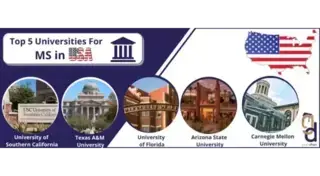
Stanford, MIT, Carnegie Mellon, UC Berkeley, and the University of Texas at Austin are some strong institutions.
Most programs last 1.5 to 2 years. Course or profession-based programs can be finished in 12 months, and research-oriented tracks can take a little more time based on the requirements of thesis work.
Check Your Education Loan Eligibility

Ask from a community of 10K+ peers, alumni and experts
Be the first to discuss this article
Ask a question or share your experience with students on GD Connect.
Add Your ResponseTrending Blogs
Similar Blogs

Network with a community of curious students, just like you
Join our community to make connections, find answers and future roommates..Country-Wise Loans
Best Lenders for Education Loan

ICICI Bank

Axis Bank

Union Bank

Prodigy

Auxilo

Credila

IDFC

InCred

MPower

Avanse

SBI

BOB

Poonawalla
Saraswat