



.webp)


















Help our experts understand you better by filling our 2-Minute Form, to find the right education loan
Get instant loan offer suitable to your profile !

On this Page:
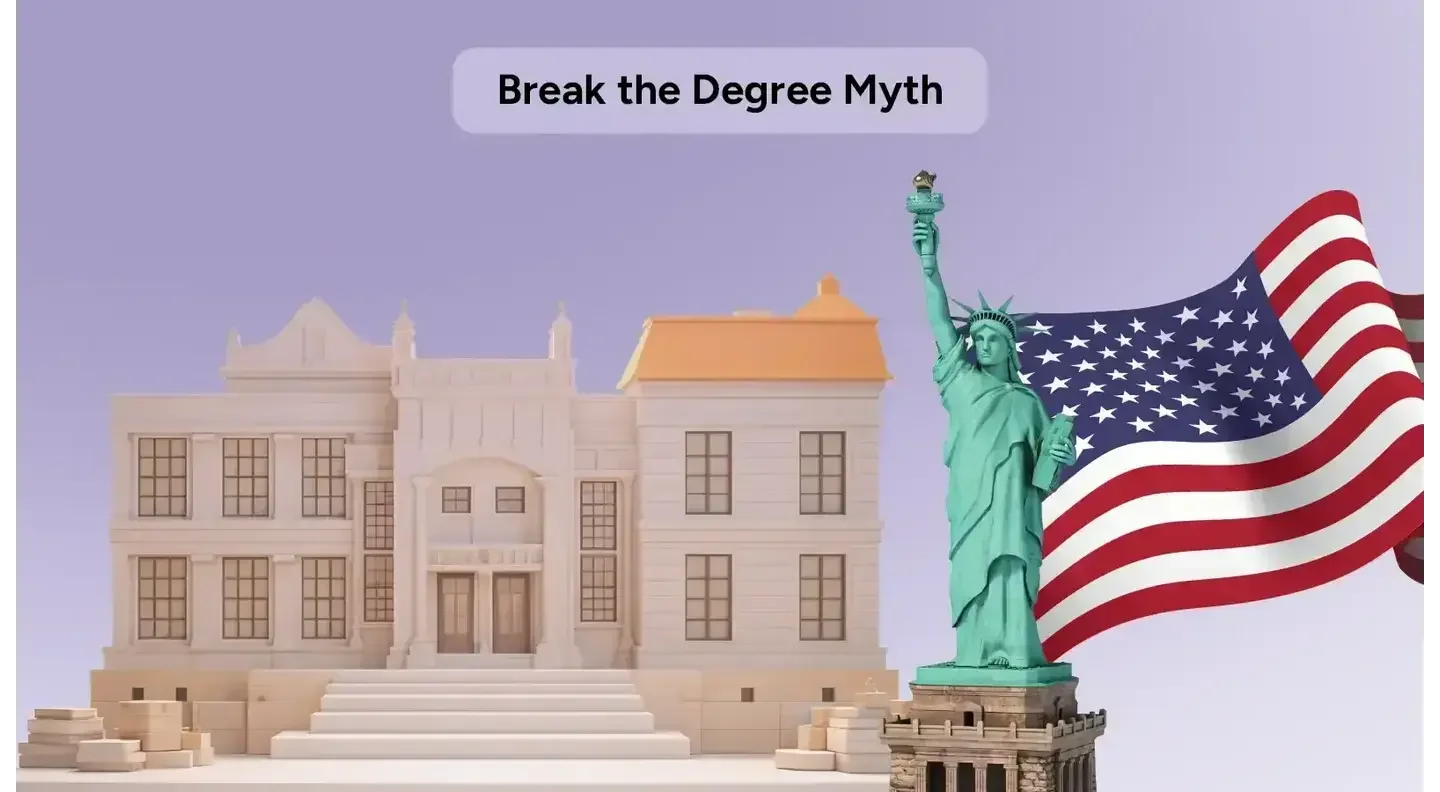
Planning to study in the USA after a 3-year degree? Learn MS eligibility, universities accepting 15 years education, WES rules & visa impact.

Indian students considering higher education abroad often face a specific dilemma around studying in the USA after a 3-year degree. Most undergraduate programs in India, such as BA, B.Sc., and B.Com. are modeled as a three-year degree, giving a total of 15 years of formal education. In contrast, U.S. universities have historically aligned eligibility with four-year bachelor’s programs. This discrepancy causes confusion in the application stage, causing the fear of being rejected and conflicting recommendations in the online forums and counselling networks. Therefore, several students are left in a state of uncertainty as to whether they are ineligible or just require an appropriate academic assessment and trajectory.

A common myth among applicants is that a three-year bachelor’s degree is outright rejected in the U.S. system. In reality, it is not automatically invalid. Whether a student can pursue an MS in the USA after a 3-year degree depends largely on the individual university’s academic policy, the chosen program, and how the previous qualification is assessed. Several U.S. universities accepting 3-year degree holders evaluate applications through credential agencies and may offer direct admission. Instead of simply declining an application, others suggest academic bridging alternatives, like extra coursework or pathway courses, to bring the qualification to the same level as the U.S. standards.
U.S. universities rely on structured academic assessment to determine eligibility for study in the USA after 15 years of education, focusing on degree equivalency, institutional credibility, and subject depth rather than duration alone.


Acceptance of three-year degrees in the U.S. depends largely on institution type and current policy. Public universities usually follow rigid state or system-wide eligibility rules, which often align with a four-year undergraduate structure. Private universities are more liberal and can evaluate the applicants individually by evaluating their credentials.
There have been instances in the past where three-year degree holders were accepted in some universities in the U.S. in selected courses, particularly when the degree is equivalent or with good academic support. Admission policies, however, are often altered based on the accreditation requirements or internal academic reviews, or decisions of the department. The position of a university this year is not a guarantee of the same next year. Thus, it is always essential to check the current and program-specific eligibility of the applicants instead of using previous examples or other unofficial web resources.
| Public Universities in the USA | Private Universities in the USA |
|---|---|
|
Florida Atlantic University |
Massachusetts Institute of Technology |
|
University of Cincinnati |
Columbia University |
|
University of North Carolina at Charlotte |
Northwestern University |
|
State University of New York at Potsdam |
Carnegie Mellon University |
|
University of Virginia |
Purdue University |
Students planning for an MS in the USA after a 3-year degree often find better acceptance in professionally oriented programs rather than research-heavy tracks. Other degree programs like MS, MIS, Data Science, Computer Science, Management, and Public Policy emphasize skills preparation, alignment at the course work level, career results more than duration of degree. These programs are structured, application-driven, and flexible in evaluating academic backgrounds. In contrast, research-intensive programs prioritize long academic training, publications, and extensive foundational study, making them less open to three-year degrees. This is why many ask, can i study ms in usa after bsc—the answer depends heavily on program type. MBA programs are a different case altogether, as they usually require significant full-time work experience alongside academic credentials.
Although flexibility has increased, there remain some academic paths that necessitate an inflexible four-year equivalent U.S. bachelor's degree. This is particularly in MBA courses, licensure-based courses, and certain engineering subjects, where academic time is prescribed by regulatory authorities. In such cases, studying in the USA after 15 years of education may not meet eligibility standards, regardless of grades or experience. Some universities, especially those that have strict accreditation or state-based academic systems, do not make exceptions in order to ensure adherence and equal academic competitiveness. These institutions focus on the similarity of eligibility requirements to prevent problems with professional licensure, immigration inspection, or course structure, so three-year degree graduates cannot enroll in certain programs.
In cases where direct admission is not possible, universities and institutions provide structured options that assist students to fulfill eligibility criteria without having to begin their academic course.
A common misconception is that work experience can replace academic eligibility for study in the USA after a 3-year degree, but it cannot. Nevertheless, the application can be greatly enhanced by the corresponding professional experience. In the case of management, MIS, and technology-oriented programs, aligned work experience reflects a pragmatic preparation, enhances profile credibility, and can have a positive impact on admission decisions where academic performance is marginal.
A three-year degree does not necessarily cause visa issues as long as the university has officially recognized the qualification. On receiving an admission offer, the university will generate a valid I-20, which confirms that your academic credentials make you eligible for the university. In the visa interview, the officers are more interested in academic progression, purposeful study, and logical flow of past education, selected courses, and future ambitions than they are in the length of the degree. If your transition from a three-year degree to a relevant U.S. program is well explained and documented, the degree structure alone is not grounds for refusal.
From a funding perspective, students planning an education loan for a 3-year degree in the USA should understand that lenders do not approve loans based on degree duration alone. University recognition, program credibility, and overall academic profile are the main factors that banks and NBFCs look at. A three-year degree that has been formally accepted in a U.S. university and an admission offer has been given is generally considered valid by lenders. However, weak accreditation, unclear pathways, or conditional admissions can delay or weaken loan approval. This is why profile evaluation before applying for loans is critical. GyanDhan can help you get a study abroad education loan without any hassle by aligning your academic profile with lender expectations early in the process.
A common mistake students make is apply blindly without checking program-specific requirements. Others rely solely on verbal assurances from agents rather than written university policies. Ignoring credential evaluation rules or assuming that all universities follow the same standards can also harm applications. Another widespread misconception is believing the U.S. system “accepts everything,” which leads to unrealistic expectations and weak application strategies that could have been corrected early on.
A well-planned approach is essential for students aiming to study in the USA after a 3-year degree, as success depends more on strategy and clarity than on degree duration alone.
Studying in the U.S. after a three-year degree is possible, but it is not universal. Outcomes vary based on institutional rules, program expectations, and how well an applicant prepares. For students exploring study in the USA after a 3-year degree, success depends on choosing the right university, applying to the right program, and building a well-aligned academic profile. It is simply a matter of making the right decisions at the right time.

Yes, some U.S. universities accept a three-year degree; however, not everywhere. It is conditional upon the university policy, specific program, and the results of a credential analysis. A three-year degree is also regarded as equivalent in some institutions, and an extra academic degree or a formal bridge is mandatory before admission.
An Indian degree is considered valid if it is awarded by a recognized university and meets academic standards set by U.S. institutions. Validity is usually determined through credential evaluation agencies, which assess university recognition, curriculum depth, and academic rigor rather than nationality alone.
An undergraduate degree of three years is not typically enough in itself, unless accompanied by other academic qualifications that make it fully equivalent.
Work experience replace academic eligibility, but relevant experience can strengthen applications, particularly for professionally oriented programs.
A higher NAAC grade strengthens credibility and positively influences credential evaluation and admissions.
Check Your Education Loan Eligibility

Ask from a community of 10K+ peers, alumni and experts
Be the first to discuss this article
Ask a question or share your experience with students on GD Connect.
Add Your ResponseTrending Blogs
Similar Blogs

Network with a community of curious students, just like you
Join our community to make connections, find answers and future roommates..Country-Wise Loans
Best Lenders for Education Loan

ICICI Bank

Axis Bank

Union Bank

Prodigy

Auxilo

Credila

IDFC

InCred

MPower

Avanse

SBI

BOB
Poonawalla
Saraswat